Stories of life on our farm in Northwest Georgia where every day is an adventure in this beautiful spot that God has entrusted to our stewardship.
Showing posts with label Mrs. Tiggywinkle. Show all posts

Monday, December 8, 2014

Parentage Verification: Some Interesting Statistics

Looking at online pedigrees the other night, I found some interesting statistics on Parentage Verification on the ADCA website.


  • 32,039 - The total number of cattle registered with the ADCA as of Dec. 7, 2014.
  • 20,182 - The number of Dexters born since April 2000, registered with the ADCA.  If you search the registry by "Birthdate," you will find animals born in April 2000 beginning on page 475 and running through the next 807 pages, for a total of 20,182 Dexters.  (There are 25 animals per page, although the count sometimes begins or ends in the middle of a page.  Some of those would be steers, of course, and not used for breeding.)  
  • April 2000 - Why is it significant?  Keep reading . . .


Searching by "Parentage DNA on the ADCA website brings up some interesting results:  
  • 791 Dexters have a genotype on file.  
  • 2,341 Dexters are “Sire Qualified."
  • 71 Dexters are “Dam Qualified.”  
  • 1,175 Dexters are “Sire and Dam Qualified.”  


If you search the “Sire and Dam Qualified” animals by "Birthdate," you will see several things:
  • The first two animals have no birthdate listed, and one was born in 1994.  Excluding these three animals . . .
  • April 2000 was the birthdate of the oldest “Sire and Dam Qualified” animal.  
  • 20,182 - The number of Dexters born after April 2000, any one of which could be “Sire and Dam Qualified.”  
  • 1,172 - The number of Dexters born since April 2000 that have been "Sire and Dam Qualified."  
  • 5.8% - The percentage of Dexters born since April 2000 that have been "Sire and Dam Qualified."  


Let's go back just to 2010, the last four years . . .
  • 7,564 - The number of registered Dexters born since 2010.  
  • 960 - The number of Dexters born since 2010 that have been “Sire and Dam Qualified.”  
  • 12.7% - The percentage of Dexters born since 2010 that have been "Sire and Dam Qualified."  
  • On the rise -  The percentage of fully PV'd Dexters born since 2010.
  • 87% - The chance you still run when buying any four-year old registered Dexter that its parents have not been qualified.  You can hope for the best, but you have no guarantee that that animal's pedigree is what it says it is.
  • 215 - The number of breeders accounting for the 1,175 "Sire and Dam Qualified" animals.  (It’s important to realize that sometimes it is an owner rather than the breeder who “Sire and Dam Qualified” the animal, as is the case for one of ours.)  Keeping this in mind . . .
  • 4 - The number of breeders accounting for 321 of the 1,175 fully PV’d animals, a whopping 27% of all “Sire and Dam Qualified” Dexters!  
  • 9 - The number of breeders accounting for 465 of the PV’d animals, almost 40%.

I did not have a way--short of counting the number of breeders on 1,282 pages of the ADCA registry--to calculate how many breeders currently have Dexters registered with the ADCA.  It would be interesting to know what percentage of all breeders are actually doing PV.  Considering that nine breeders have done almost 40% of all PV'd animals, I would guess the percentage is not great.  However, I have two more very significant statistics for you . . .
  • 12 - The number of Area Directors plus the President of the ADCA, currently in the process of discussing Parentage Verification and the direction the ADCA will take in the future.  And finally . . .
  • 1 - The number of breeders it takes to effect change.  If that "one" is you . . . and you . . . and you . . . and you . . . change will happen, one person at a time.  Contact your Area Director and let them know you support full Parentage Verification as a requirement for registration.  Thank your director and the Board for moving in the right direction.  And even more importantly, don't wait for the Board's decision.  Start getting your herd PV'd today!


Tuesday, December 2, 2014

Parentage Verification: Why Is It Important?

Parentage Verification is something that has been my goal to achieve for our entire herd ever since I understood what it meant.  I posted previously about our whole herd now being "Sire and Dam Qualified."  Here I'm all excited, while you may be asking, "So what?  What's the big deal?"


We have two black polled cows, Ebony and Siobhan.  I can easily tell them apart, but the rest of my family can't.  This year we had two calves born on our farm.  Ebony, above, had a black polled heifer we called Tiggy.

Six weeks later Siobhan had a red polled bull calf named Wellie.  My previous post ended with the account of how Wellie was parentage verified at the UCDavis VGL.


"So," you might say, "that seems like a whole lot of trouble and expense just to prove what you already knew--that Wellie is Siobhan's calf by Cash!"  It's true that there's no way I could confuse Tiggy and Wellie, so why did I bother with all the PV stuff?

It all started this past summer when someone made this statement on the Dexter forum I belong to:

"The very term "Sire Qualified" describes a useless status. Comparing the genotypes of an alleged offsprin (sic) with an alleged sire can not show any meaningful level of assurance that the two are related. The only parentage verification worth anything is "Sire and Dam Qualified."  (I will not identify the poster by name because they have since deleted their post and I cannot provide a link to it.)
I was confused, so I called VGL to get an explanation.  The person I talked to was astounded that "Sire Qualified" had been called useless.  However, as she further explained Parentage Verification, I understood that the poster was trying to say this:

"Finally, it is important to remember that while parentage exclusions are 100% accurate parentage qualifications are not. The accuracy of most animal parentage tests is greater than 99% when both parents are included in the analysis and drops to around 95% when only one parent is included in the analysis. However, this accuracy will decrease when the potential parents are part of a large group of closely related animals." 

The very helpful lady at the lab gave me an example using actual genetic markers from a case they were working on.  (She did not tell me the name or even the breed of the animal.)  I can't remember the markers and numbers she used, but here's a simplified version of what she told me using a fictional "Marker A":

If the lab compares the calf's and sire's genotypes:
Calf: Marker A 100/200
Sire: Marker A 100/300
This bull qualifies as this calf's sire.

If the lab compares the calf's and dam's genotypes:
Calf: Marker A 100/200
Dam: Marker A 100/400
This cow qualifies as this calf's dam.

However, if the lab compares all three animals at the same time:
Calf: Marker A 100/200
Sire: Marker A 100/300
Dam: Marker A 100/400
One of the parents does not qualify.

Remember what I wrote in my previous post?
"You'll remember that an individual (in this case, a cow) gets half of its genetic material from each parent, so this animal got the 217 from one parent and the 221 from the other. Hold that thought; it's going to be important."
Well, now it's important.  This calf cannot have gotten the "100" from both parents; the "200" had to come from one of them, but neither of the parents has a 200 on that marker . . .

Somebody's got a problem!

The example above is very simplified, but this scenario has actually happened, even with Dexters.  People have bought cattle . . . and when they tried to PV those animals, they learned that one or even both of the parents on the pedigree did not qualify as the sire and/or dam.  Here is a recent discussion about just such an issue on the Dexter forum.

If you read the entire discussion, you will see that experienced breeders shared some excellent advice:  The only way to be sure that something like that does not happen to you is to buy only "Sire and Dam Qualified" animals for breeding stock.  


We have owned Dexters since December 2009.  Our first calf, Siobhan, was born in 2010, over four years ago.  She was PV'd--because we had her genotyped at TAMU and they did it automatically.  When we bought Ebony, we got her genotyped at VGL so her previous owner could PV her calf because the sire was there.  They had bred Ebony and had her sire's genotype at VGL, so it was easy enough for me to get her PV'd.  I could see that it was the highest "G" level accorded on the pedigree, but I still didn't understand why it was important!

Two things helped me realize how vitally important PV is:
1)  My conversation with the lady at VGL, and
2)  My acquaintance with the serious problems a few fellow breeders were facing as they discovered that their prized Dexters didn't even carry the bloodlines for which they had purchased them.

Accidents happen.  An AI'd cows slips her calf and gets field bred by a different bull . . . A bull jumps into a pasture, breeds a cow, and jumps back out again without anyone knowing . . . A neighbor's bull does the same thing . . . Two cows switch calves with each other . . . A bull calf gets left with the herd too long and breeds an open cow . . . The steer running with the open cows wasn't completely castrated . . .  These are actual scenarios that have happened, and they cause nightmares for the new owners and headaches for the breeders who have to sort out the real parents.

This is why we wanted that highest "Sire and Dam Qualify" designation.  Now that our herd sire and cows are all fully PV'd, one simple test for every calf born on our place will guarantee its lineage.

We believe that Parentage Verification is an indispensable part of good breeding--the crown of all our efforts and the final stamp of certainty for our clients.  If we've gone to the trouble to breed an animal, we ought to guarantee that it's everything we say it is.  With PV, we rest assured that the animals we sell are exactly who we say they are!

Feel free to use the "Contact Susan" form under the ADCA logo on the right of this blog if you have any questions.  If you prefer to talk on the phone, send me your phone number and I'll be glad to call you.  Stay tuned for an upcoming Q&A on Parentage Verification.

Saturday, November 15, 2014

An Eventful Week in Review

This has been an eventful week that would definitely get mixed reviews.

On Sunday I found Robin laying out flat in the barnyard with one leg curled under her and the wing on the same side partially splayed out.  She was very cold and snuggled into me when I picked her up.  I brought her into the laundry room and put her in a milk crate lined with hay with some water and crumble at hand, and I put a floor lamp with lots of wattage next to her to warm her up.  She ate and drank a bit and seemed pretty bright-eyed, although she didn't seem at all inclined to move.

On Monday Kim Newswanger arrived to pick up Tiggy, and of course we went out to let Kim say hi to Ebony since Kim was her first mama.  You can imagine my shock when just as I was taking this photo, Kim said, "What's this?"  Ebby had a lump on the underside of her jaw just about where Kim's hand is in the photo.  Neither of us knew what it was, and it was very hard to see through the long hair under her jaw, but it was obviously painful.  There was a small scab which I picked off, and it had a small amount of pus on the inside.  A call to the vet was in order.

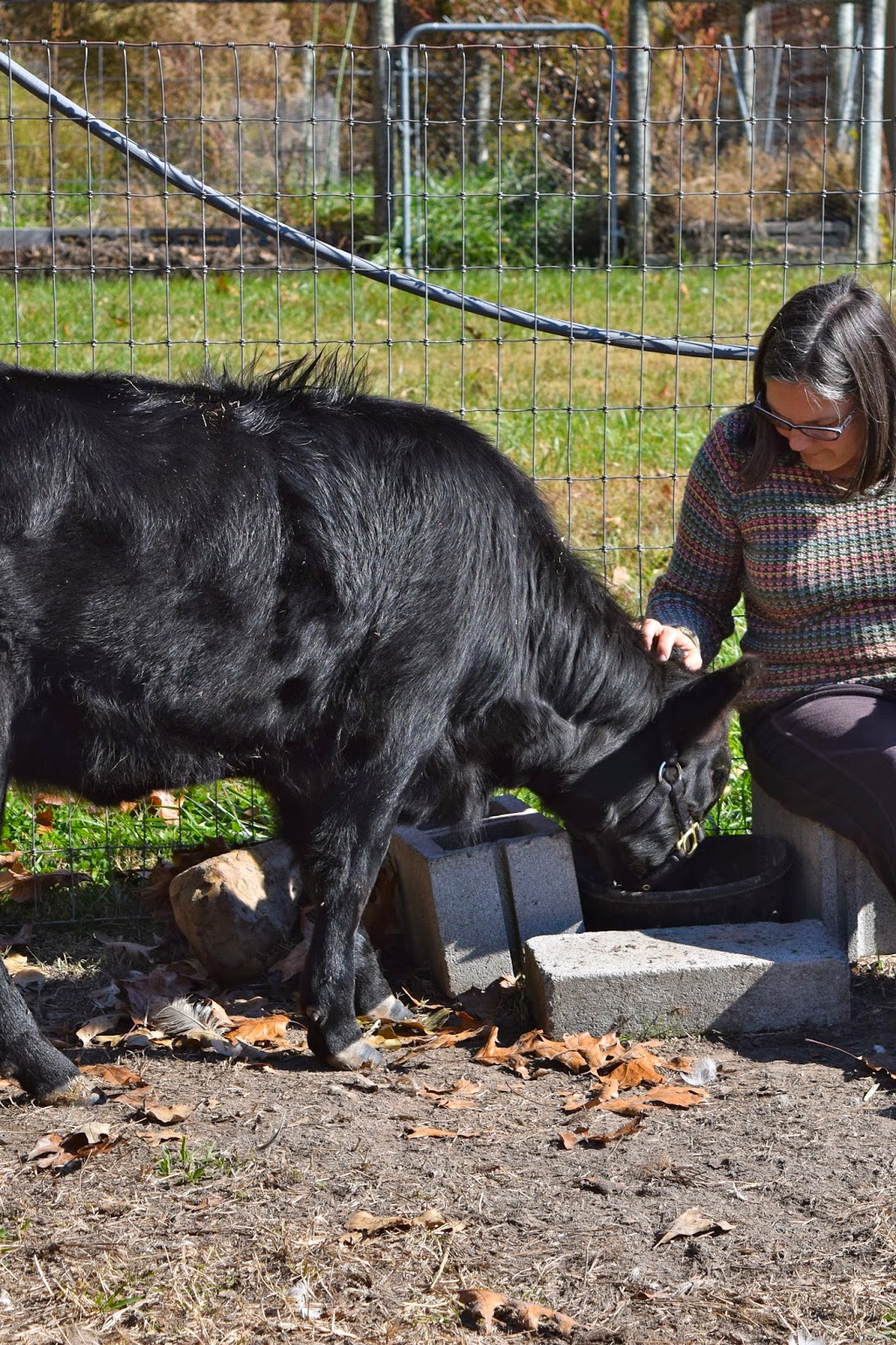
I had warned Kim that I have not been able to make friends with Tiggy.  This is as far as we've gotten--and only while she's eating!  As soon as the grain is gone she backs away from me.  Her "safety zone" has gradually gone down from about 10 to 2 feet, but she is definitely wary of us.
We had to corner Tiggy to catch her and put Kim's halter on her.  I've told Kim all along that she's a cow whisperer and that as soon as Tiggy meets her she'll melt in a big puddle of chocolate all over Kim.  It wasn't quite that dramatic, but Tiggy warmed up to her pretty quickly!

With a lot of coaxing, Kim led Tiggy out to the trailer, and she hopped right in!  One thing that made me feel a tiny bit better was that Tiggy was actually grinding her teeth as Kim led her--the process was apparently that agonizing!  She recovered quickly--after just a few days at her new home, she comes right up to Kim for treats and scratches.  I told Kim that my story (since Tiggy isn't telling a different one) is that this smart little cookie heard in utero that she wasn't meant to be ours, that she was meant to go back to live with Kim.  I think she's just been waiting all this time for her real mama to come get her, so why waste any affection on me?  :)

After Kim and Tiggy left, we switched animals to different pastures.  Now that Tiggy is gone, we don't have to keep Royal two pastures away from her, so we moved the cattle up to Kara's pasture, their winter sacrifice pasture.   Angel, Brandy and Julie had been in the back of Kara's pasture getting to know Romeo over the electric fence, but I wanted them to have a lot more room for their first official meeting so we put them all out where the cattle had been.  Of course everyone took off galloping!

While Angel and Brandy found some green grass, Julie went over to meet Romeo.

"Hi." BAM!  I guess being the smallest and lowest on the totem pole, she wanted to put him in his place right off the bat.

Romeo realized Julie was not his Juliet, and he high-tailed it out of there.

 Of course the harem followed right on his heels.


Don't we have a colorful bunch?  (In more ways than one!)

We also have some very opinionated ladies, and Brandy's opinion is that SHE is the Alpha mare!

Finally the girls hared off on their own and left Romeo alone.  He has always been a sweet, peaceful guy and pretty low on the totem pole as long as we've known him.

As the sun set, equine relations seemed to reach détente.

Meanwhile, I had called the vet about Ebby's lump, and he said he'd try to get here in a day or so.  I was worried that she might have something called "lumpy jaw," which I knew was serious, and I wanted to get her seen as soon as possible.


Finally I finally found a vet who could come on Wednesday.  So that afternoon we got Ebby in the squeeze chute to get her lump checked out and see what had caused it.  The vet shaved the lump and gave her a thorough examination, including looking inside her mouth.  Although he had never actually seen a case of lumpy jaw, he said that it is usually located farther back on the jaw, closer to the cheek.  He said that Ebby's lump seemed to be an abscess, probably caused by inflammation from new teeth, and it appeared to have already drained.  The lump, while still tender, felt thick and didn't have an open channel.  As a precaution, he cleaned it well with an antiseptic and took a swab in the small bloody spot that was visible after cleaning.  The culture would take a week to get results, and he told me to keep iodine on it in the meantime.  I felt reassured, although I was still concerned.

Wednesday morning I had noticed that Robin seemed to be going downhill.  Figuring it couldn't hurt and might encourage her to move, I fixed up a pen for her on the back porch in the sunshine and put her there with food and water.  She simply lay there, uninterested in anything.  When the sun moved, I shifted her to take advantage of the warm rays.  Later that afternoon when I came back to check on her after treating Ebby, poor Robin had died.  I was glad she'd had the sun on her back for her last morning.

Late Thursday afternoon I got a call from our main cattle vet.  He had hoped to get out here but wasn't going to make it, so he was checking on Ebby.  He said that he was pretty sure she had an abscess and that normally he would drain it and give her a shot of Excede, a long-acting antibiotic.  Since it had already drained, if I wanted to meet him somewhere, he'd give me the Excede.  So Friday morning I got Ebby into the squeeze chute and gave her the shot--although it wasn't quite as simple as it sounds.  Cows HATE shots!  Nevertheless, thanks to the squeeze chute, Ebony got her Excede.  I was glad to see that the lump had shrunk some more and was definitely less tender.

By this morning the lump looked smaller, although I think Ebby may always have a lump of scar tissue.  She let me scratch it, though, which I took as a good sign.

Herb had clued me in to something he had observed, and I could hardly believe what he told me.  So I took the camera with me this morning so that I could write a fitting end to the story of this week.

It may not be too surprising to see Romeo pin his ears at Julie and tell her to leave his grain alone.  After all, she was the first to try to kick his teeth in!
And it may not be surprising to see Angel, close to Romeo and warning Julie off, especially if you remember that Angel knew Romeo long ago before he went to Texas.  What is really astonishing is what you DON'T see in this photo--Brandy!  That's because Brandy was up eating hay . . . which she could finally do after Romeo left.

Meet Romeo, the new Alpha!  Angel--the only one who didn't try to kick him--is his sidekick, and Brandy--the former Alpha--is neck and neck with Julie for last place.  I think Romeo is saying that the moral to this story is:  "He who laughs last, laughs best!"

Sunday, August 10, 2014

Using Estrotect Patches and AntelBio's ELISA Milk Pregnancy Test

In a previous post I wrote that Royal had been put in a pasture with Ebony and her heifer Tiggy on June 18.


I put two Estrotect patches on Ebby and observed them twice daily when I fed her.  When new, they look like the one above.  The red line and "Estrotect" tell you that there is red underneath the silver; the patches come in various colors.  (When one is removed, it leaves a sticky patch on the hair, as above.)

By June 26, this is what Ebby's two patches looked like.  There's a lot of mud on them, but you can see that most of the silver is still intact with very little red showing.

Estrotect's site shows a patch that looks like these, minus the mud.  The caption says "Don't breed."  That's because they assume you're using the patches to time artificial insemination, and this coloration on the patch shows that the cow is not in "standing heat" where she allows other animals to mount her because she's ready to be bred.
For our purposes, these patches mean "She isn't bred."

Meanwhile, we had to go away for two days, and I wanted some reliable information on what was transpiring between Royal and Ebby while we were gone.

So I pulled off the loosened upper patch, cleaned the lower one, and applied a new one over it (top photo).  I wanted to replace the patch, but it was stuck on so well that it would not come off.  I couldn't complain.  That's what makes these things work--because they stick on like they're glued.

We were gone June 28th and 29th.  On the 30th, this is what Ebby's new patch looked like.  A patch with even less red than this one on Estrotect's site bore the caption "Breed."  For our purposes, it said "She's bred!" All that remained was to wait 35 days from June 29th to collect a milk sample from her and test it.

AntelBio can perform an ELISA pregnancy test on a milk sample from a cow (this obviously doesn't work for first calf heifers).  This avoids the cost of a farm call and having an invasive palpation done on your newly pregnant cow--a real win/win situation.  In addition, although the website still says the test can be run 35 days post-breeding, when I called to find out more about it, the lady I talked to said the test is actually accurate at 28 days, and they will be updating the website to reflect that.  That is earlier than any vet I've ever heard of can palpate a pregnancy.

What is ELISA?  AntelBio's site says: ELISA (pronounced E-LIZA) stands for Enzyme Linked ImmunoSorbent Assay.

  • Measures pregnancy-associated glycoproteins (PAGs), to determine pregnancy status. PAGs are released by the placenta during pregnancy and are specific to pregnancy unlike some other chemical indicators, such as progesterone.
  • Uses ELISA technology, a rapid and trusted diagnostic method.
  • High level of accuracy (98%), comparable to palpation, ultrasound, and blood testing.
  • Effective from 35 days post breeding until dry-off.
  • Available within 24 hours of samples arriving at DHI lab.
  • Quickly access results online through a personalized database system.
  • Results reported as pregnant, open or recheck based on the level of the PAG’s present.
How do you submit a sample?

After talking to the helpful customer service representative, I decided to order a $14 kit for my first time.  It came promptly.  The kit includes a postage paid box (the photo is farther down) for returning the milk samples, clear instructions, a Sample Submission Form, and 5 lockable milk tubes containing preservative.  There is no need to freeze or refrigerate the milk samples.

The kit is made to send off five samples at once, but it worked fine to send off just one, too.  I saved the other four tubes along with photocopies of the sample submission form and a copy of the instructions for future use.

Here are the instructions.

Here's a tube with the preservative in it.  You do not need to wear gloves, but since my hands were rough, I did.

Sorry, I couldn't manage to photograph myself while milking with one hand and holding the tube in the other!  You'll just have to take my word that the orange stuff in the tube is actually Ebby's milk already picking up color from the preservative.  It is NOT a melted creamsicle!
Here is the tube, locked and shaken to thoroughly mix in the preservative.
To carry the tube back to the house, I put it in an empty ProBios jar with a spare tube (in case I goofed) laying in the bottom).  Since I drive out to the barn in my Doodad, I didn't have to worry about the vibrations causing the tube to bounce off the seat.

In the background you can see the handy brochure explaining the test, which I was offered when I placed the order.  The same information is on the website, but I'm old-fashioned and like something I can hold in my hot little hand without running into the computer.

I was sure to mark the tube with Ebby's tattoo and name, also on the Sample Submission Form.  The foam lining that came in the box held one tube just as securely as it would five.

I covered the tube with the second piece of foam and added the Sample Submission Form.  It does cost a total of $9.50 to test one sample, and I received the bill after my results.  However, the total cost for this preg-check--kit and test--was $23.50.  I can't get a vet to drive up our driveway for anywhere near that!  The next four tests will cost less because I already have the tubes.  It will be $9.50 per test plus shipping, probably under $15 per test.

Finally, I sealed up the box and ran it to the Post Office on Monday, Aug. 4.

On Wednesday, Aug. 6, I got an email that my results were waiting on the website.

There it was . . . PREGNANT!  It was that easy and that quick for AntelBio to verify what the Estrotect patch made me suspect:
Royal is going to be a daddy!   *cow*

The customer service representative explained that the value of 2.184 does not really mean anything.  They have not been able to correlate numbers with length of gestation or expected due dates, but thanks to Estrotect, we have an idea on that, too.  We should be seeing Royal's first calf on the ground somewhere around April 4, 2015.

Granted, this isn't the same as becoming grandparents, but it's pretty exciting, nevertheless.  We know this calf will be obligate A2/A2, non-chondro and non-PHA.  Beyond that, we'll just have to wait and see whether it will be a heifer or a bull, polled or horned, red or black.  But we've answered the two important questions:
  • Is she pregnant?
  • When is she due?
The rest is just icing on the cake!

Monday, July 28, 2014

Do Not Walk in Front of Me . . .

You have probably heard a version of this quote (which is apparently often--and erroneously--attributed to Albert Camus):
Do not walk in front of me, because I may not follow;
Do not walk behind me, because I may not lead;
Just walk beside me and be my friend.
You may have seen a funny version of it online:
Do not walk in front of me, because I may not follow;
Do not walk behind me, because I may not lead;
Do not walk beside me, either--
Just pretty much leave me alone!
Well, Ebony would like to share her bovine version, brought to you by her heifer, Tiggy:
Do not walk in front of me, because I may not follow;
And whatever you do, DON'T walk behind me!!!

Tuesday, July 22, 2014

Welcome Home Surprises

We were gone for 10 days to Texas to visit family and attend a Stephen Ministries Leadership Training Course in Dallas.  Kara was our faithful farm sitter who kept animals fed and water tanks full during some of the hottest days this summer.

Once we had greeted Kara and the dogs we were off to feed and say hi to all the animals.

The first--and very pleasant--surprise was that when I hollered "Ooooh, cow!" the first one running to greet us was Tiggy!  She still wouldn't let us touch her, and she didn't want any of the feed we were offering, but she sure came running.  She looks so much bigger than when we left!
 
The next surprise was seeing how much Wellie has grown.  Kara texted us photos while we were gone of Tiggy and Wellie touching noses through the fence at feeding time.  Neither one is interested in their mamas' feed--they just want to be friends!

This "cow" in the back pasture is 13 1/2 month old Macree, Siobhan's heifer from last year.

Macree has grown nicely and is looking good.

However, a not-so-nice surprise (Kara fore-warned us) is that Macree has a new admirer.  Royal apparently found a spot in a fence that he could get through, and he abandoned Ebony, his "intended," for a cute young thing.  We were glad that Kara knew better than to try to come between a bull--even a nice one like Royal--and a heifer in season!

So we have a fence-repairing job in order to keep Royal where he belongs!  We also have the vet coming to give an injection of Lutalyse to Macree as a precaution.  He said that although she is in good condition, she's too young to be bred.  If she is indeed bred, she would calve almost two months before her second birthday, at least two months too early.

There's never a dull moment on a farm, not even when you go away.  And the work is never done because just when you think it is, the animals will find a way to make some more!  But we were thankful to have had them in good hands while we were gone--and even more thankful to be back home.