Stories of life on our farm in Northwest Georgia where every day is an adventure in this beautiful spot that God has entrusted to our stewardship.
Showing posts with label Barnyard. Show all posts

Tuesday, September 8, 2015

The "Other" Hardware Disease

A year and a half ago, I did a post about hardware disease in cattle and how to help prevent it.  Today I'm posting about the "other" hardware disease.

First, the background.  I wanted to hang a reminder on the chicken coop door to "Close Nest Boxes."  (If we don't hang doormats over the nest boxes in the evening, the chickens roost in them and our eggs end up covered in poop.  Blech!)  So I grabbed a couple of short sturdy nails and a hammer to tack up my sign on the door.

Bang! Bang! Bing!  Suddenly the nail flew right out of the wood, bounced off my chest and disappeared into thin air.  That was NOT good!  Yes, our cattle have rumen magnets, but magnets won't help them if they step on a nail, and besides, I don't really want them eating nails!  So I needed to find that nail, but a thorough scan of the grass in front of the coop ended in failure.

I headed to the hay barn to find one of our big magnets--either the flexible magnet or the big rolling one.  I came up empty-handed--and this is where the "other" hardware disease comes in.  This hardware disease affects humans!

"What is this dreaded disease?" you may well ask.

The above scene illustrates the human version of hardware disease--a chronic failure to put things in their proper place when you're done with them.  The result of this disease is that when you really need something--like a magnet to recover a nail before it injures a cow--you will experience the symptoms of this debilitating disease:  irritation, anxiety, high blood pressure, and excessive sweating as you tromp from place to place looking for the required piece of equipment.

Here is what my crisis looked like--pretty much like trying to find a needle in a haystack.  Without a magnet to find my nail, I resorted to desperate measures.  I plunked myself down on the ground, chicken poop and all, and combed my fingers through the grass, trying to find the nail.  When that failed, I raked a manure fork through the grass, hoping to see the sun glint off it as it bounced into the air.  Failure again.

So I headed to the house to ask Herb if he knew where the magnets might be.  He didn't, but he did help me search the hay barn shelves.  I've been a bit leery of those shelves ever since I found a baby copperhead on one of them, but with Herb to back me up I overcame my trepidation enough to actually move things around.

And there it was, the flexible magnet, masquerading as a bit of jumper cable.

I double-checked that the magnet would, indeed, pick up my missing nail, then I hurried to the barnyard to get it before Siobhan or Remy could eat it or step on it.  I raked the magnet repeatedly through the grass and repeatedly came up empty.  Maybe the 45 wasted minutes had been just enough time for Siobhan to step on the nail, I worried.  So I picked up her feet (good training at a young age!) to make sure she was okay.  Well, I picked up her front feet and one of her rear feet, at which point she'd had enough and wandered off.

That nail had simply disappeared into thin air. I thought back over the moment it flew out of the wood and bounced off my chest.  It was so frustrating!  It was almost as if it had fallen down inside my shirt--but I knew it hadn't because I'd already checked.  Even though I knew from checking that it hadn't gone down inside my T-shirt, the thought made me clap my hand to my chest.

Something poked my hand.  Something in the bottom of my T-shirt pocket.

This is my painting and varnishing shirt, so it's stained.  It also has a little point at the bottom of the pocket, and that's where the nail went.  Don't ask me how that nail managed to fall through the slit of the pocket opening; if I had been required to make it fly in there to save my life, I would be dead!

Instead, I laughed my way all the way back to the hay barn where I put the magnet exactly where it's supposed to go.

And I kept on laughing all the way back to the house where I informed Herb that there's one more item on our To Do list for the fall--get that hay barn whipped into shape.  I refuse to fall victim to hardware disease again!

Saturday, August 29, 2015

Storm Clouds and Rainbows: An Update About Holding On

This is an update on my June 15 post, The Cow, the Calf, the Crisis, the Kids and the Creator.


June and July have difficult months for me, often resembling a sunset through storm clouds.  Shortly after I wrote the June 15 post, I got the results of the milk culture back.  There was no growth reported in any of Siobhan's quarters, but she had a horrendous SCC (somatic cell count) of over 4 million in the Right Rear (Pseudomonas) quarter.  I didn't know whether to feel happy over the "no growth" or worried about the SCC; I was just confused!  I knew that an SCC could remain elevated even after the mastitis was gone, but surely not that much.  Dr. A had been out sick, so none of my questions got answered; in fact, I never have gotten to talk with him again.  I've finally concluded that he was rather like the angel God sent to stop Abraham from sacrificing Isaac--he saved Siobhan and disappeared offstage.

Wondering if I had tested too soon after the antibiotics, I decided to send off a test to AntelBio, a lab that tests for the DNA of mastitis-causing organisms.  That means that even if an antibiotic treatment was preventing growth in a culture, any organism present would still show up through its DNA.  Those results confused me even more!  They showed that both Right quarters had no detectable organisms, but one or both of the left ones (I had combined them in the last tube I had) had 1+ Prototheca spp., contagious algae carried in water.  On top of that, it turns out that AntelBio doesn't even test for Pseudomonas, so the negative result wasn't reassuring at all.

That meant I needed to send off one more test to TQML since they test for both Pseudomonas and Prototheca.  This time the test came back showing NO Prototheca, but with 60 CFU/ml of Pseudomonas and the SCC down to 2.7 million.  (For comparison purposes, when Siobhan originally had Staph A in February 2014, the count was 659,000 CFU/ml.  When I got a report of 60 CFU/ml of an environmental bacteria at dry-off, Susan told me that small amount was probably a contaminated sample.)  So I was left with lots of questions . . . Was this a contaminated sample? . . . Had the PA never gone? . . . Or was it back?  Susan did tell me that with Pseudomonas, it's not unusual to have a negative test followed by a positive one.

Meanwhile, another problem had appeared.  About the 12th of June I noticed that Siobhan seemed to be in pain when I was milking or Remy was nursing, although her quarters seemed normal in size and the milk was flowing well and without clumps.  In fact, for the first time in her life she was regularly lifting a foot in protest, and I resorted to using hobbles on her.  As I investigated what could be causing her pain, I discovered long sores high up in the "cleavage" where her front quarters joined her body.  The sores were hidden in her thick coat and only became obvious when I tried to shave the area.  Her reaction made it clear that this was VERY painful.

I prepared hot water with eucalyptus, lavender and tea tree oils and used it to apply hot, moist compresses to the area.  Then, a bit at a time over a period of days, I shaved and pulled away the nasty clumps of dried exudate and hair.  What was left was raw, red, oozing sores.  I realized that they were right in the area where the thick edge of the Tamm udder net had touched Siobhan, and I was sick at heart to realize that I had caused this, too.  I tried a variety of things to help soothe the area until my friend Kirby Allen suggested that it sounded like a fungal infection.

So I switched to using Colloidal Silver ointment, which seemed to ease the pain as soon as I smeared it on, followed by Lotrimin Anti-fungal spray.  Every morning I dragged Siobhan into the stanchion to eat her grain while I did her soaks and treatment.

By that time it was the end of June.  I was down to once a day milking, and Remy was pretty much handling everything on his own.  My sisters were due to arrive July 1 to celebrate my 60th birthday, so I milked Siobhan for the last time on June 28.  After agonizing over what to do and when and how, I finally came to the conclusion that I didn't know enough to do anything at that time.  Siobhan had been in the barnyard with her Pseudomonas, and keeping her there longer wasn't going to change that.

Except for the sores, Siobhan was looking healthier and actually getting a shine on her coat.  So I decided to just hold on and let her raise Remy as long as possible.  There was no rush to make a decision, and I would try to enjoy the month of July with my family, ignore the undercurrent of sorrow that lurked just below the surface, and cross the next bridge when I came to it.

By the end of July, the right-hand sore was mostly healed, with new hair growing back.  I stopped the soaks on that side, but continued to monitor it and apply Lotrimin every few days.

The left-hand sore was much better, with most of the rawness gone and no further clumps of exudate appearing.  I was thankful for small blessings like Siobhan not being in pain any more.
I continued daily treatment on the left-hand sore, and now at the end of August, most of the hair has grown back.  I continue the daily treatments, however, unwilling to take the chance of a relapse.

The final piece of news is that this past Monday, Aug. 24, I sent off milk samples to TQML for a mastitis re-test.  I got the results Thursday, and to my complete surprise, there was no growth after 72 hours.  Nothing.  Nada.  Zip.  The SCC results are confusing (to both Susan and me), and I think I might have mixed up the two right-hand tubes.  At any rate, I'll test again in a month.

This entire saga has been like a roller coaster ride.  While I'm trying not to hope too much, I'm very thankful for this unexpected blessing, and I'll continue to leave Siobhan's future in God's hands.  Meanwhile, Remy is a funny, lively little guy and Siobhan is her usual sweet self.

What a relief that I don't have to drag her into the stanchion any more!  She comes over to the gate, waits until I open it, and walks right in.  I don't even have to shut the neck catch.  She eats her grain, I do her treatment, I give her some apple treats, and when I open the gate she backs out.  It's obvious that she wants to be out of the barnyard, and every three weeks she moos for Royal, but I think we can both hold on a little while longer.

A special "Thank you" to all of my family and friends who have prayed so faithfully for Siobhan!  Some of you like Herb, Kara and Barbara have been right beside me when it was hard to make myself go out to the barnyard.  Others of you I only know through the internet, but your caring messages have encouraged me more than you can know.  So thank you!  And please keep praying!

Friday, March 20, 2015

Just When We Think We're in Charge . . .

Dexters are pretty smart.  Siobhan's dam Sara weaned Siobhan all by herself without any human intervention.  After we sold her back to Kim, she witnessed exactly how Sara went about weaning her calf.  One day Sara kicked her calf off and wouldn't let it nurse.  The next day, she let it nurse.  The next day, she kicked it off again.  That smart old cow took her calf to every other day nursing to wean it and dry herself off!

Siobhan is just as smart as Sara, although maybe a little less determined.  Last February I noticed Siobhan kick Macree off when Macree was 9 months old.  Macree would not be dissuaded, though, so I intervened with a weaning tab.  The same thing happened this February; Siobhan gave Wellie a good kick to let him know the milk bar was closed.

Then Wellie got castrated, and Siobhan seemed to sense that he needed comfort, so she let him start nursing again.  Shortly after that I threw my back out, and the family told me to take a break from chores.   After three days of rest, I went out to the barnyard to check on the animals.  To my surprise, Siobhan had apparently decided that Wellie was sufficiently comforted, and she had kicked him off.  Her udder was bursting with milk, so I decided to start once a day milking.

Just to be sure Wellie had gotten the message, I put a weaning tab in his nose.  Poor little guy, he had just about forgiven us for the castration, and then this!

After a few days, I noticed that some mornings I was getting almost no milk at all.  At best, one side would have milk and the other would be empty.  I knew Siobhan wasn't self-sucking because I had put her harness on as soon as she weaned Wellie.  I figured that naughty Wellie must be nursing through the weaning tab, so I booted him out of the barnyard to join the other cattle.

The next morning the barnyard gate was pushed out as far as it would go, and one side of Siobhan's udder was empty.  I figured Wellie must be nursing through the wires of the gate despite his weaning tab, so Herb and I covered the bottom of the gate with chicken wire.  The next morning, as expected, we got all of Siobhan's milk.  It looked like we had solved the problem!  Sir Loin was hanging around the barnyard visiting Siobhan (as he had visited his buddy Wellie) and talking to her in little "baby" moos.  I thought it was odd, but kind of cute.

And then a couple days later I glanced out the back door.  To my horror, Sir Loin was nursing on Ebony who is due to calve in early April!  I ran out to check, and sure enough, all four of her teats were wet!  Sir Loin was banished immediately to a different pasture, and I post-dipped all of Ebony's teats before I turned her loose.

Suddenly Sir Loin hanging around the barnyard, the soft little moos, the gate pushed out, and Siobhan's empty quarters all made sense.  It wasn't poor Wellie nursing around the weaning tab; it was Sir Loin nursing through the gate!  And when we foiled him by adding chicken wire, he managed to convince Ebby to let him nurse on her.  I told Herb that Sir Loin looks tastier every day!

With the sneaky nurser banished, the only remaining problem was that Siobhan's harness was not holding up very well.  So I decided to try a product designed to support heavy dairy cow udders--Tamm Udder Support.  Two days after I ordered it, Siobhan was decked out in her new lingerie.  The sunlight shows her udder through the netting.  This is good for air circulation, but in order to be sure she wouldn't try self-sucking, I secured a clean cloth inside the net on her left side.

NOTE:  I now very strongly advise against using the Tamm Udder Support for any cow.  It ended up being disastrous for Siobhan (story here).  Another family cow milker told me in June 2015 that her vet advised her that using it would be asking for mastitis.  I wish I had known that piece of information in March.

You can see from the loops that even the small size support is a little large for a Dexter, but it is easily adjustable.  This is much more comfortable than Siobhan's old harness, and she seems happy to be able to turn her head freely.

You can see that there are numerous ways to customize the fit.

For milking, it was pretty easy to undo the two back buckles and one side buckle above the udder support without removing the entire harness.

We've had a fair amount of rain, and the cotton canvas dries out easily.  Of course, with all the rain, Siobhan's new lingerie is now a nice muddy beige.

Siobhan will remain in the barnyard wearing her harness until she's completely dried off.  Once I'm sure she won't be tempted to self-suck again, she can ditch the harness and join the boys until it's time for her to calve.

Her pre-drying off mastitis test came back with no Staph A, but I'll continue to keep her separate from Ebby as a precaution.  The episode with Sir Loin nursing first Siobhan and then Ebby is a reminder that even when we think we're in charge, we might not be.  We have to stay on our toes to keep ahead of our Dexters!

At least for now, everyone is where they should be.  Siobhan is drying off in the barnyard.  Ebby is about to move into the Home Pasture for calving.  Once she does, Sir Loin's banishment will be lifted and he can rejoin the bachelors.  It looks like we're back in charge again, for now . . .

NOTE:  Just in case you missed the warning above, I'll repeat it here:  I now very strongly advise against using the Tamm Udder Support for any cow.  It ended up being disastrous for Siobhan (story here).  Another family cow milker told me in June 2015 that her vet advised her that using it would be asking for mastitis.  I wish I had known that piece of information in March.

Saturday, February 21, 2015

Wellie's Castration Story

When we decided last summer that Wellie would be castrated, I talked to our vet about when and how to do it.  He advised doing it when Wellie was 4-5 months old, by cutting rather than banding.  He wanted to wait until Wellie was old enough for his vaccines and fly season was past.

He said he would give Wellie a shot of tetanus antitoxin as well as a tetanus vaccine (and his other vaccines) at the same time.  In the absence of a previous tetanus vaccine, the antitoxin would prevent any chance of tetanus while the vaccine built up immunity over a two week period.  We had heard tragic stories about people who castrated calves and gave tetanus vaccines, only to have the calves die of tetanus before the vaccines could build up immunity.

Unfortunately, life got in the way for the vet and us, and we were unable to get him here when planned.  Finally, I decided that at 8 1/2 months Wellie really needed to be castrated, and I called another vet.  (We like to keep good relations with several vets for cases just like this when one can't make it.)  The second vet also prefers castrating as less painful, uses the same tetanus prevention protocol, and agreed to use a local anesthetic.  So we set a date for the deed.

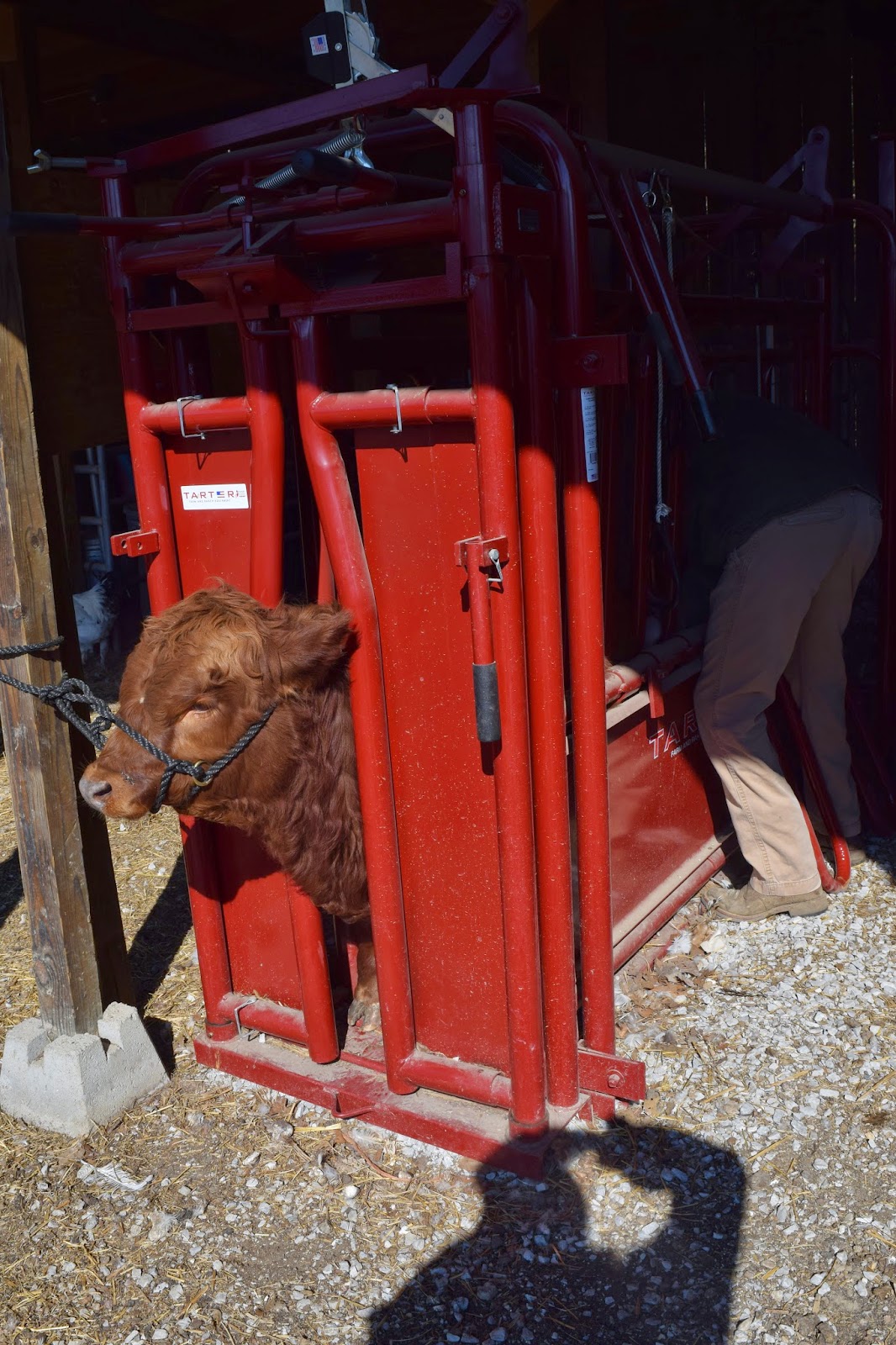
On Feb. 11 we put Wellie into the squeeze chute.
The vet folded down several of the squeeze bars so he could reach Wellie and administered the local anesthetic.  He gave it time to take effect while he gave vaccines to Wellie and Ebony.


I saw that the vet used a tool called a Newberry knife and made a slit in the back of the scrotum.  After that I went up by Wellie's head and did not see the actual operation.  I learned later that some vets cut off the bottom portion of the scrotum to allow for drainage, but ours made an incision in the middle.  It bled a little, but not much, and the vet said it would swell up and remain swollen for several days.  When I asked about disinfecting the site, he said I could use 1/2% iodine, so I sprayed some on.

During the operation, Royal came over to check on Wellie.  Of course, when it was his turn later to get in the squeeze chute to get a magnet, he did NOT want to go in!  I assured him that considering the per capita price we had paid for his testicles, they were quite safe!

Wellie jumped more over his immunizations than he did over the local.  He struggled a bit during the surgery, but less than I have seen cows fight over a shot.  Although the vet says they have more pain with banding, I don't think there is a painless way to castrate.

I know some farms do not castrate meat animals, but we simply do not have enough pastures to keep intact bull calves separate from cows and heifers.  As he has gotten older, Wellie has engaged in more head-butting challenges with Royal and Sir Loin, the older steer.  Being so small, he gets pushed around, and although he has never been hurt, I hope that he will now act less like a bull.

I do not like castration.  I wish it didn't have to be done, and I'm sure Wellie did, too.  But if we are going to be responsible breeders, we have to make sure that a bull calf that is not breeding quality is not breeding our cows and heifers.
I kept a frequent eye on Wellie to be sure he was okay.  The rest of that day and the next, he was moving slowly (to be expected), but was nursing, eating hay and chewing his cud.  Then on the morning of the 13th, I found him laying partly on his side with his legs spread out as if to keep them off his swollen scrotum.  When I got him up to check on him, his rumen was hollow (showing he had not eaten a lot of hay), and he looked peaked.  Half of Siobhan's udder was full, so he had obviously not nursed much, and I decided to take his temperature.  It was 24° out, so Wellie might be expected to register lower than the bovine normal of 101.5°, but his temperature was 103.9°.

I was quite concerned and called the vet, who had gone out of town!  Not only that, his partner does not do farm calls, and he didn't have another vet to cover for him.  So I called the original vet I had hoped to have do the castration.  He agreed that Wellie's temperature was too high and said if I would meet him, he would give me an antibiotic.  I made the two-hour round trip and came home with Excede, a long-lasting antibiotic, as well as a bottle of Banamine to relieve pain and fever.  Pain inhibits animals from healing, and when they are given pain relief, they tend to heal more quickly.

Herb was gone all day, and I was pretty sure from previous experience giving shots to cattle, that I would not be able to do it alone, even with the squeeze chute.  So I called on our neighbor, Randy, who came over with his son to help.  Excede is very thick and must be given sub-cutaneously behind the ear--never in a vein or muscle--using a large-bore needle.  Banamine goes in the neck muscle with a smaller needle.  Wellie objected strenuously enough, even in the chute, that I was very thankful for help holding him.

Randy, who grew up with cattle and had seen many castrations, felt that the bulge of tissue protruding from Wellie's incision was not normal.  I had no frame of reference at all, but tended to agree with him.  When I posted a photo later, other cattle owners agreed.  Once Wellie was medicated, I took a bucket of hot water and cleaned the incision of dried exudate, making sure it could continue to drain as necessary.  I also applied oil of oregano around the incision on the advice of my family cow friends.  Within a couple hours, Wellie was obviously feeling better, eating better and had nursed Siobhan out.

Herb and I gave him Banamine the next morning to make sure he continued to feel well and eat well.  He objected much more vigorously than he had the day before, so I decided that if he felt that good, he didn't need any more Banamine.

Wellie is back to normal now, and his scrotal swelling is gone.  He's eating well and acting lively.  Here he is visiting with his buddy Sir Loin at the barnyard gate.

Today Wellie wanted to nurse, and Siobhan pushed him away several times.  (That's another story.)  In a fit of temper, he charged one of the ducks.  The snow in the barnyard was slippery and crusty with ice, so Wellie hunched his back and crow-hopped across the barnyard, landing each jump on all four feet, pursuing the hapless duck who fled with flapping wings as fast as his short little legs could go.

Without a camera, all I could do was stand there and laugh.  The duck escaped with everything intact except his dignity, and I was just happy to see Wellie feeling so fine.

Thursday, February 5, 2015

The Pleasures and Pitfalls of Share Milking


In traditional dairying, calves are removed from their mothers at birth or shortly thereafter and fed with milk replacer while their mothers are milked twice a day in order to sell their milk.  On smaller farms and homesteads, farmers sometimes remove the calf from its mother, milk the cow and bottle feed some of the milk to the calf while keeping the rest for the house.  Others use a foster cow to nurse one or more calves while milking the other cows.  There are numerous variations of this system, usually requiring the farmer to milk twice a day.


One of the things that attracted me about Dexters is that they are well-suited to share milking.  With share milking, the calf remains with its mother.  After the calf is a week or two old, it's separated from the cow for up to twelve hours (usually at night) to allow the farmer to get one milking.  The calf is then returned to its mother to nurse for the rest of the day.

There are several things I like about share milking:


  • I love the idea that our cows get to raise their own calves the way God created them to.  That's how heifers learn to be cows; and dam-raised bull calves are less likely to become aggressive with humans.
  • I love that our calves get a good start in life with their mother's healthy milk instead of artificial milk replacer.
  • I'm a lazy milker and don't want to have to milk twice a day, which is usually necessary when a calf is removed from its dam since her udder produces milk 24 hours a day. 
  • Bottle feeding a calf is a lot of work, and it can be difficult to get it right.  Too little milk, and the calf doesn't thrive; too much, and it scours.  
  • I like to take days off and go on vacations, something no dairy farmer can do without an experienced relief milker.  With share milking, the calf is a willing relief milker. 
There are also several potential problems with share milking:


  • I get less milk because the cow makes sure her calf gets what it needs, and I get what's left over.

  • I get less cream because, believe it or not, cows can selectively "hold up" and save the cream for their calves. 


  • Some people feel that calves that get used to nursing are more likely to suck on other calves after weaning.  So far, this has not been our experience.


  • This past year, milking kind of got away from me.  I knew that we would have to be gone several times during the summer, so I kept both calves on their dams and just milked occasionally when we needed milk.  I was concerned that if I milked one of the cows on a daily basis, I would encourage her to build up her milk supply beyond what her calf could easily handle when I had to be gone.  So our cows got to be mamas and our calves got to be babies for most of the summer.

    Tiggy was weaned in October before going to her new home, and I dried Ebony off, leaving Siobhan as my milk cow and Wellie as my relief milker.  Then a fencing break in November meant the cattle had to move to a pasture too far from the barn for convenient milking.  In December I got sick and couldn't get well, so I went two months without milking. Although I missed the time with my cows and we missed our fresh milk, it was a relief that Wellie stepped up to the plate as relief milker without a single complaint.  :)

    Recently I've started milking again.  To my delight, Siobhan has slipped into our new routine without a hitch, and Wellie, whose halter training ended practically before it started, has been easy to work with.  I've switched to evening milking because I've been hesitant to shut Siobhan away from Wellie overnight for fear she would start self-sucking again.  In the winter, trying to put her anti-self-sucking harness on in the dark is more than I want to tackle.  So I separate Siobhan in the morning and milk about nine hours later when we do evening feeding.

    Today, however, was a first for me in share milking.  When I went out at 5 p.m., Wellie was standing at the gate like a small red shadow of Siobhan.  "How cute!" I thought, "and how nice that we don't have to go fetch him and lead him all the way to the barnyard."

    As I opened the pasture gate, I commented to Herb in passing that "the boys" had pushed it in toward Siobhan so hard that it was difficult to open.

    I tied Siobhan up to eat her grain while Herb led Wellie into the milking parlor.  I was surprised that Wellie followed Herb so nicely and didn't try to go nurse while his mama ate dinner, but I was gratified at how tractable he was.

    Wellie settled down to munch on Siobhan's hay while I got her into the stanchion.  To my surprise, her udder that should have been full and tight was floppy.  It didn't feel like she was holding her milk up; it just felt like there wasn't much in there.  And there wasn't--a measly one and a half cups!

    "Could she possibly have been self-sucking because I didn't put her harness on?" I wondered.   I didn't think she could have drained all four quarters equally, but I had no idea what was wrong.

    When it became obvious that I wasn't going to get much milk, I untied Wellie and decided to let him clean up.  To my astonishment, Wellie couldn't have cared less.  I couldn't even get him to look at Sibohan's udder, much less nurse.  And suddenly the light dawned!

    The pasture gate that was pushed in toward Siobhan . . .
    . . . Wellie waiting right by the gate . . .
    . . . Siobhan's empty udder . . .
    . . . Wellie completely uninterested in nursing--

    They were busted!  The little stinker had nursed through the gate and drained his mama dry!  And the big stinker had turned herself around so the little stinker could nurse both sides!  Look back up at the photo of Wellie by the gate, and you'll see what a feat of patience that was on both their parts.

    As I told Herb when I came inside with my measly haul of milk, at least today's milking wasn't a waste of time because we learned something!  I learned more about a cow's desire to mother her calf and got a glimpse of bovine problem solving.  And Herb learned that if he wants milk again, there's a new job on his Honey-Do List--line that gate with chicken wire!

    Despite the fact that we have to tweak our management a bit, I'm still committed to share milking.  We get plenty of milk for our needs, and far be it from me to interfere with that kind of God-given maternal instinct!

    Saturday, January 31, 2015

    Better Bite Bloat in the Butt!

    Last spring I did a post about our first bout with bloat, a true bovine emergency.  We have now had a second bout with bloat--in the middle of the winter with no clover in sight!  So here I am, once again, to share things we're learning . . . so others can hopefully learn from our mistakes and avoid them!

    This photo was taken on Jan. 19 in the early afternoon.  I was still recovering from the winter crud, and Herb had been doing almost all of the feeding since doing much of anything left me exhausted.

    This was as adventurous as I got--using a telephoto lens to peek at the cattle enjoying a bit of shade on a warm winter day.

    All five cows were chewing their cud together in the shade, but when I looked out a bit later, Siobhan was at the other end of the pasture eating on the hay bale.

    I looked out yet again and saw the same thing--Siobhan skipping the cud chewing party to dine at the hay bale.  It was unusual enough that I told Herb I wanted to feed her evening grain and check on her.
    I went out about 4:30 to check on Siobhan.  Siobhan was eager for her feed, and I let her eat it to keep her still while I checked her over.  It didn't take long for me to notice her bulging side and to be worried about her.  As long as she was still, I pressed my ear to her side and listened to her rumen.  There were no nice rumblings, just a few crackles--NOT good!  So I haltered Siobhan to take her up to the barnyard.  As I led her out of the pasture, she gave a little "drive by" poop that plopped down in two places as she walked--not a nice reassuring, I'm-not-budging-till-I'm-done-with-this-serious-buisness poop!  Take my word for it:  It's a fact of life with cattle, you WILL become a "connoisseur" of poop, and Siobhan's puny plops were just not doing it for me.

    I took the photo (above) on my cellphone after we got to the barnyard, so I could text it to the vet.  While Herb walked Siobhan around, I went back to the house to get our "Bloat Kit," which consisted of a bottle of Therabloat and a large needle-less syringe to drench her with it.  (I sincerely hoped I could avoid having to use the plastic tubing that I bought in case I ever needed to shove a tube down a cow's throat into her rumen!)  The dark bulge at the bottom center of the photo is Siobhan's hip, and the large ballooned expanse bulging toward her head is her bloated left side.

    This photo shows Siobhan's hip bone on a level with the switch of her tail.  You can see from the photo that her left side, where the rumen is located, is distended and very full, although not bulging up above her backbone.  My guess is that she was somewhere on the way from mild to moderately bloated.  These photos are of a cow that was more severely bloated, so severely in fact that her owner didn't stop to take photos until the cow deflated down to the stage shown in the photos!  Thanks to Louise of Carragheen Dexters for sharing her story and photos.  At any rate, Siobhan's rumen was very rounded and firm to pressure, and rumen sounds were absent.

    Having been through this before, we knew the drill, and while we waited for the vet to call back, we took turns walking Siobhan rapidly around and around the barnyard.  She had interrupted Wellie's nursing to go eat her dinner, and she was extremely indignant that we were keeping her away from her baby!  So it really wasn't a challenge to keep her moving--all it took were occasional pulls on her lead rope to channel her energy in the direction we wanted.  Whenever I needed to stop for breath, Herb massaged Siobhan's rumen firmly to get the gas moving.  It sounds a bit crazy, but it really helps, and the massage was often followed by some encouraging gurgling sounds.  I kept laying my ear against her rumen, checking for those melodious notes.  If you spend much time around cattle, you'll also become a fine arts aficionado--feeling your heart lift to a nice tenor rumble or plummet to hear a soprano cellophane crackle.

    After about 15 minutes of this, I was not happy with our progress.  Siobhan was still bloated with no good rumen sounds and no burping, and she began to arch her back like she wanted to poop.  She did this every few minutes, with no result at all or just a measly bit of poop.  This is a sign of physical discomfort and stopped up "plumbing."

    So into the squeeze chute she went.   Cows make terrible patients!  They do not understand, "I'm doing this for your own good," so a squeeze chute is invaluable when a bloating cow needs to be drenched.  The squeeze sides held her still, with Herb's help to hold her head, while I got the syringe filled with Therabloat into her mouth and squeezed it a bit at a time down her throat.  You can't hold her head too high or she'll choke, but if you let her drop it down, the precious medication runs out.  You have to develop a feel for when the head is in just the right position so the only option is for the patient to take what's coming to her and swallow it!

    About that time the vet called back.  He suggested we give Siobhan Gas-X, which is simethicone, but unfortunately that was about the only gas remedy that Herb didn't have in his medicine cabinet!  Since we had just given the Therabloat, we decided we would wait it out and give it time to work.  Herb really had to finish some case notes, so he went back to the house while I continued to walk Siobhan rapidly around the barnyard.  I still wasn't happy with her progress, so I started calling Dexter friends that might have dealt with bloat.  I was very thankful when I heard Melissa Parker of Nonesuch Farm on the other end of the phone.

    Melissa had dealt with bloat before, and she had some excellent advice besides the Therabloat and massage.

    • Keep her moving!  
    • Get her chewing!  Tie a bit or a stick in her mouth to make her chew, which will make her burp.
    • Cut out her grain for a few days.  Cows can get acidotic after an episode of bloat, and we needed to withhold grain for 2-3 days.

    This photo is not the best quality because it was taken at about 6:15 as it was getting dark, but you can see the bit I rigged up for Siobhan.

    Luckily I had a large (size 5) Dexter halter, a snaffle bit with big side rings, and a couple of spare carabiner clips--and voila!  Siobhan's Big Blue Bloat Busting, Belching Bitted Halter!

    Believe me, Siobhan was NOT amused!  Unfortunately, I can't offer any videos of how her halter worked because by that time we were bouncing quite indignantly around and around the barnyard, but the bit was what finally turned the corner.  Siobhan was definitely chewing at it--trying to spit it out--and it wasn't long until I heard a lovely rumbling belch!

    I listened for regular rumen sounds, counted three long belches, and noted a couple of decent poops.  Best of all, there was a hollow in Siobhan's rumen where before it had resembled a large, firm beach ball.  A half hour after the bit went in, I pronounced her "cured" to the best of my ability.

    It was also almost pitch dark, and I could barely see to lead Siobhan back to the pasture.  She was a black shadow fading onto the dark hillside, first calling loudly, then in soft mama moos.  After a few moments, a small shadow at the bottom of the hill baby moo-ed back, and Siobhan took off galloping and bucking down the hill to find her calf.  All's well that ends Wellie, I guess.

    The question we had to figure out was WHY did Siobhan bloat?  This wasn't the frothy bloat that Ebony got from lush clover in the spring.  So what happened?  This excellent article on bloat gave me a few answers.

    1. Earlier in the winter the cattle were eating coarser first-cut hay.  About a week before this happened, we put out a new bale of finer second-cut hay.  I was concerned that it might not have enough roughage, and I've since been told this could have been a factor.  The cattle did have constant access to the hay bale, which is very important, but after the bloat episode, I asked Herb to throw some of the horses' coarser hay (from an older bale) over the fence for the cattle.  Believe it or not, they actually left the "nicer" bale and came up the hill to eat the coarser hay, Siobhan included.
    2. I'm the one who replenishes the minerals, and with being sick I had not thought to ask Herb to check on them.  If the animals' salt consumption decreases, they may drink less water, which can contribute to bloat.  I can't remember now if there were minerals left in their tub at the time or not, but it's an easily avoidable bloat factor that I won't forget again.
    3. We had recently switched Siobhan from 11% all-grain sweet feed to 14% non-GMO multi-species pellets.  The article on bloat cites small feed particle size as a contributing factor for bloat.  Small particle size is found in pelleted feed, as opposed to all-grain.  I had been sure to make the change gradual and added probiotics to Siobhan's feed during the process, which is the way to change feed.  However, given the way pellets break down more quickly in the rumen, it seems likely that the feed itself was a contributing factor.  This is not enough to make me switch back to GMO all-grain, but it is enough to make me watch more closely.  After withholding grain for three days as Melissa suggested, I worked Siobhan back up to a pound twice day instead of 2 pounds twice a day.  She doesn't really "need" the grain to maintain her weight, so she now gets it just to keep her coming up to the barn twice a day, which makes it easier when I want to shut her up for milking.
    4. The weather had suddenly changed from a week with  daytime highs of about 32° to a high of almost 60° the day Siobhan bloated.  As surprising as it seems, weather changes are a factor in bloat.  Obviously, that is nothing we can control, but we can be aware of it and be more vigilant for other potential factors that could cause bloat.
    As emergencies go, this one was kind of an "also ran".  I'm not sure that Siobhan's life was in danger, and she might have recovered with no treatment at all.  However, I was not willing to take the chance when a $3 bottle of medication and a couple hours of my time might make the all the difference.  This episode has reinforced in my mind the importance of several things:  Constant access to free choice hay and loose minerals; daily interaction with your animals to check on them; familiarity with their normal habits; and keeping a box of basic emergency supplies available.  

    There's one more thing our "bloat kit" needs (besides a new supply of Therabloat), and that's a trocar.  A trocar is definitely one of those tools you hope you never have to use.  It's similar to a hollow ice pick that you stab into the cow's rumen to allow the excess gas to escape.  It sounds horrendous,  but it beats losing your cow.  One woman I know, who lives in a remote area far from vets, found her beloved cow down, seriously bloated and gasping for breath after getting cast in the barnyard.  Knowing that her cow was dying, this gal grabbed the steak knife she used to cut hay strings, cleaned it quickly in teat dip, and stabbed her cow in the rumen to let the gas escape.  That's not something any farmer wants to do, but as this gal said, when the alternative is watching your cow die in agony, you'd be surprised what you can do!

    We know that no matter how well you care for your animals,  things can and do go wrong.  I'd much rather use a trocar than have to resort to using a steak knife on a living animal . . . so the emergency cow box is getting a trocar to add to the tubing, the syringe and the bottles of Therabloat.  If we never have to use them and they sit there gathering dust, it was cheap insurance!  If we should need to use our emergency kit, we'll be ready to kick bloat's butt!