Stories of life on our farm in Northwest Georgia where every day is an adventure in this beautiful spot that God has entrusted to our stewardship.
Showing posts with label Artificial Insemination. Show all posts

Friday, January 23, 2015

Toystory, a Role Model to Inspire Our Dexter Bulls

The following column by Ron Hart was printed in the Chattanooga Times-Free Press today.  I wanted to share the link here, but couldn't find the column on Ron Hart's website.  So I emailed to ask him if the column had been published online anywhere because I thought it was so hysterical I wanted to share it on my blog.

He replied quickly, thanking me for my compliment, and gave me this link.

Thank you, Ron Hart, for allowing me to share this!

NOTE:  In the interests of accuracy, let me point out that Toystory, as a Holstein bull, was almost certainly being used to increase milk production, not beef.  The article could be interpreted in that way, and I wanted to add that disclaimer, lest my readers think I don't know the difference between a Holstein and a Hereford!  ;)

Here's a Genex link about Toystory's record setting achievement.

Here's an article about Toystory's passing, along with a photo.  Google also came up with some videos of Toystory at work, but in the interest of good taste, I won't provide a link here.  You'll have to do your own search!

R.I.P., Toystory, may our Dexter bulls be as virile as you were, if not quite as prolific and a whole lot smaller.  Twenty-seven hundred pounds?!  I'll take a Dexter any day! 

Monday, December 8, 2014

Parentage Verification Questions & Answers

Q:  What is the difference between genotyping and parentage verification?

A:  Genotyping uses a sample of your animal’s DNA to read its genetic fingerprint.  It is a DNA profile that identifies your animal.  Parentage verification goes a step farther:  It compares your animal’s genotype (genetic fingerprint) to those of its sire and dam in order to qualify them as its parents.

Q:  What if I’m not sure which are the parents of my calf?

A:  Parentage verification can be done for multiple possible sires and even dams.  Comparing their genotypes with your calf’s genotype can exclude any sire or dam that could not be a parent of your calf.  For the most accurate exclusion, both sire (or sires) and dam (or dams) must have their genotypes included.  VGL has an excellent explanation on their website.  

Q:  All my Dexters are registered.  Why should I bother to PV my calves?  Their parents are both registered, so they can be registered, too.

A:  VGL’s website says:  “For over four decades, parentage verification has been utilized in animal registration programs. Breeder experiences have proven that parentage testing, in combination with well run breeding programs, can ensure accurate pedigrees.”  A breeder’s integrity and reputation depend on the accuracy of their animals’ pedigrees.  When a breeder sells a calf as having a certain pedigree, and subsequent PV by the new owner shows that the pedigree is wrong, the breeder’s breeding practices and even their honesty can be called into question.

Q:  But surely such things rarely happen?

A:  Just this year (2014), one Dexter owner PV'd two cows they had bought and learned that the prestigious sire on their pedigrees was not, in fact, their sire.  With the breeder's cooperation, it was finally determined that two different bulls had actually sired the two cows in question.  

At almost the same time, another Dexter owner had the same problem happen with three different cows.  Two of the cows eventually had the correct parents identified, but although this owner has been trying for more than seven months to get the breeder to determine the correct sire of the last cow, at this time the sire is still unknown.  None of the three cows ended up having the bloodlines for which the owner had bought them.  So unfortunately, these kinds of situations are not that uncommon.

Q:  If I bred my cow to a registered Dexter bull, isn't the bull already "Sire Qualified" or even "Sire and Dam Qualified?"

A:  Not necessarily.  The ADCA merely requires all bull calves to be genotyped for registration:  
  1. When registering bull calves, geno lab results must be included with registration. 
Of the 34 AI sires listed on the ADCA website, only six are "Sire and Dam Qualified."  Twelve are "Sire Qualified," and 16 simply have their genotype on file.

Q: Why do some ADCA AI bulls have a blank next to Genotype?
  
A:  One important consideration for your future success in having your offspring PV'd is where a bull's genotype is on file.  Only 9 of the 34 ADCA AI sires state that their genotypes are on file both at TAMU and VGL.  Ten have their genotypes on file only at TAMU.  Fifteen of the bulls do not have the location of their genotypes specified, leaving a blank next to Genotype.  If you have your cows' genotypes on file at one lab and use a bull whose genotype is on file only at the other, it could be more complicated for you to PV your calves, especially if the bull is deceased.  You might need to have your cow genotyped at the same lab as the bull to accomplish it.  

If your cow and the bull you use are both at TAMU, you can "Sire and Dam Qualify" your calf simply by listing the parents' names on the test form.  For VGL, you will need to ask the bull's owner for a Case Number in order to "Sire and Dam Qualify" the calf.  

If you are using an AI sire, it would be wise to get an extra semen straw to send to the lab of your choice if the bull is not already on file there.  It's worth the extra expense to have the peace of mind that your calves are PV'd.

Q:  I’m convinced that I should genotype and PV my animals, but I’m not sure how to do it.  Who can help me?

A:  Contact your Area Director.  There is a list of the Area Directors and their contact info on the ADCA website.  They should be able to answer any questions you have. 

There are several posts about the process on this blog, and if you still have questions, I would be glad to help.  You can contact me using the "Contact Susan" form under the ADCA logo on the upper right hand side of this blog.

Q:  I genotype and PV my calves, but the results are my private property.  I don’t send results to the ADCA because they are no one’s business but my own.  Why should I publicize my animal’s test results?

A:  You hurt yourself and your animals by not sending test results to the ADCA.  More and more people are buying only "Sire and Dam Qualified" breeding stock, and when people look at your animals' pedigrees, it appears that they have not been tested.  With so many sellers offering fully PV'd stock, many buyers will pass you by.  However, when you send results to the ADCA that your animals are fully PV’d, you provide a public guarantee of their pedigree to interested buyers.


NOTE:  The ADCA Registrar does not make public your animal’s genotype nor your TAMU Accession Number or VGL Case Number.  The test results merely serve to authorize the Registrar to designate your animal as “G5” or “Sire and Dam Qualify.” 

Hopefully this has helped answer some questions about Parentage Verification.  If you have any other questions, please ask them in a comment or through the "Contact Susan" form so I can answer them publicly for the benefit of others.  I'll also be glad to email you or call you if you give me your phone number.

Thanks to S&H Hilltop Sara, our first cow, and our first calf, her heifer ZH Zephryhill Siobhan, for gracing this post with their photos.

Sunday, August 10, 2014

Using Estrotect Patches and AntelBio's ELISA Milk Pregnancy Test

In a previous post I wrote that Royal had been put in a pasture with Ebony and her heifer Tiggy on June 18.


I put two Estrotect patches on Ebby and observed them twice daily when I fed her.  When new, they look like the one above.  The red line and "Estrotect" tell you that there is red underneath the silver; the patches come in various colors.  (When one is removed, it leaves a sticky patch on the hair, as above.)

By June 26, this is what Ebby's two patches looked like.  There's a lot of mud on them, but you can see that most of the silver is still intact with very little red showing.

Estrotect's site shows a patch that looks like these, minus the mud.  The caption says "Don't breed."  That's because they assume you're using the patches to time artificial insemination, and this coloration on the patch shows that the cow is not in "standing heat" where she allows other animals to mount her because she's ready to be bred.
For our purposes, these patches mean "She isn't bred."

Meanwhile, we had to go away for two days, and I wanted some reliable information on what was transpiring between Royal and Ebby while we were gone.

So I pulled off the loosened upper patch, cleaned the lower one, and applied a new one over it (top photo).  I wanted to replace the patch, but it was stuck on so well that it would not come off.  I couldn't complain.  That's what makes these things work--because they stick on like they're glued.

We were gone June 28th and 29th.  On the 30th, this is what Ebby's new patch looked like.  A patch with even less red than this one on Estrotect's site bore the caption "Breed."  For our purposes, it said "She's bred!" All that remained was to wait 35 days from June 29th to collect a milk sample from her and test it.

AntelBio can perform an ELISA pregnancy test on a milk sample from a cow (this obviously doesn't work for first calf heifers).  This avoids the cost of a farm call and having an invasive palpation done on your newly pregnant cow--a real win/win situation.  In addition, although the website still says the test can be run 35 days post-breeding, when I called to find out more about it, the lady I talked to said the test is actually accurate at 28 days, and they will be updating the website to reflect that.  That is earlier than any vet I've ever heard of can palpate a pregnancy.

What is ELISA?  AntelBio's site says: ELISA (pronounced E-LIZA) stands for Enzyme Linked ImmunoSorbent Assay.

  • Measures pregnancy-associated glycoproteins (PAGs), to determine pregnancy status. PAGs are released by the placenta during pregnancy and are specific to pregnancy unlike some other chemical indicators, such as progesterone.
  • Uses ELISA technology, a rapid and trusted diagnostic method.
  • High level of accuracy (98%), comparable to palpation, ultrasound, and blood testing.
  • Effective from 35 days post breeding until dry-off.
  • Available within 24 hours of samples arriving at DHI lab.
  • Quickly access results online through a personalized database system.
  • Results reported as pregnant, open or recheck based on the level of the PAG’s present.
How do you submit a sample?

After talking to the helpful customer service representative, I decided to order a $14 kit for my first time.  It came promptly.  The kit includes a postage paid box (the photo is farther down) for returning the milk samples, clear instructions, a Sample Submission Form, and 5 lockable milk tubes containing preservative.  There is no need to freeze or refrigerate the milk samples.

The kit is made to send off five samples at once, but it worked fine to send off just one, too.  I saved the other four tubes along with photocopies of the sample submission form and a copy of the instructions for future use.

Here are the instructions.

Here's a tube with the preservative in it.  You do not need to wear gloves, but since my hands were rough, I did.

Sorry, I couldn't manage to photograph myself while milking with one hand and holding the tube in the other!  You'll just have to take my word that the orange stuff in the tube is actually Ebby's milk already picking up color from the preservative.  It is NOT a melted creamsicle!
Here is the tube, locked and shaken to thoroughly mix in the preservative.
To carry the tube back to the house, I put it in an empty ProBios jar with a spare tube (in case I goofed) laying in the bottom).  Since I drive out to the barn in my Doodad, I didn't have to worry about the vibrations causing the tube to bounce off the seat.

In the background you can see the handy brochure explaining the test, which I was offered when I placed the order.  The same information is on the website, but I'm old-fashioned and like something I can hold in my hot little hand without running into the computer.

I was sure to mark the tube with Ebby's tattoo and name, also on the Sample Submission Form.  The foam lining that came in the box held one tube just as securely as it would five.

I covered the tube with the second piece of foam and added the Sample Submission Form.  It does cost a total of $9.50 to test one sample, and I received the bill after my results.  However, the total cost for this preg-check--kit and test--was $23.50.  I can't get a vet to drive up our driveway for anywhere near that!  The next four tests will cost less because I already have the tubes.  It will be $9.50 per test plus shipping, probably under $15 per test.

Finally, I sealed up the box and ran it to the Post Office on Monday, Aug. 4.

On Wednesday, Aug. 6, I got an email that my results were waiting on the website.

There it was . . . PREGNANT!  It was that easy and that quick for AntelBio to verify what the Estrotect patch made me suspect:
Royal is going to be a daddy!   *cow*

The customer service representative explained that the value of 2.184 does not really mean anything.  They have not been able to correlate numbers with length of gestation or expected due dates, but thanks to Estrotect, we have an idea on that, too.  We should be seeing Royal's first calf on the ground somewhere around April 4, 2015.

Granted, this isn't the same as becoming grandparents, but it's pretty exciting, nevertheless.  We know this calf will be obligate A2/A2, non-chondro and non-PHA.  Beyond that, we'll just have to wait and see whether it will be a heifer or a bull, polled or horned, red or black.  But we've answered the two important questions:
  • Is she pregnant?
  • When is she due?
The rest is just icing on the cake!

Thursday, April 10, 2014

Mrs. Tiggywinkle Is Here!
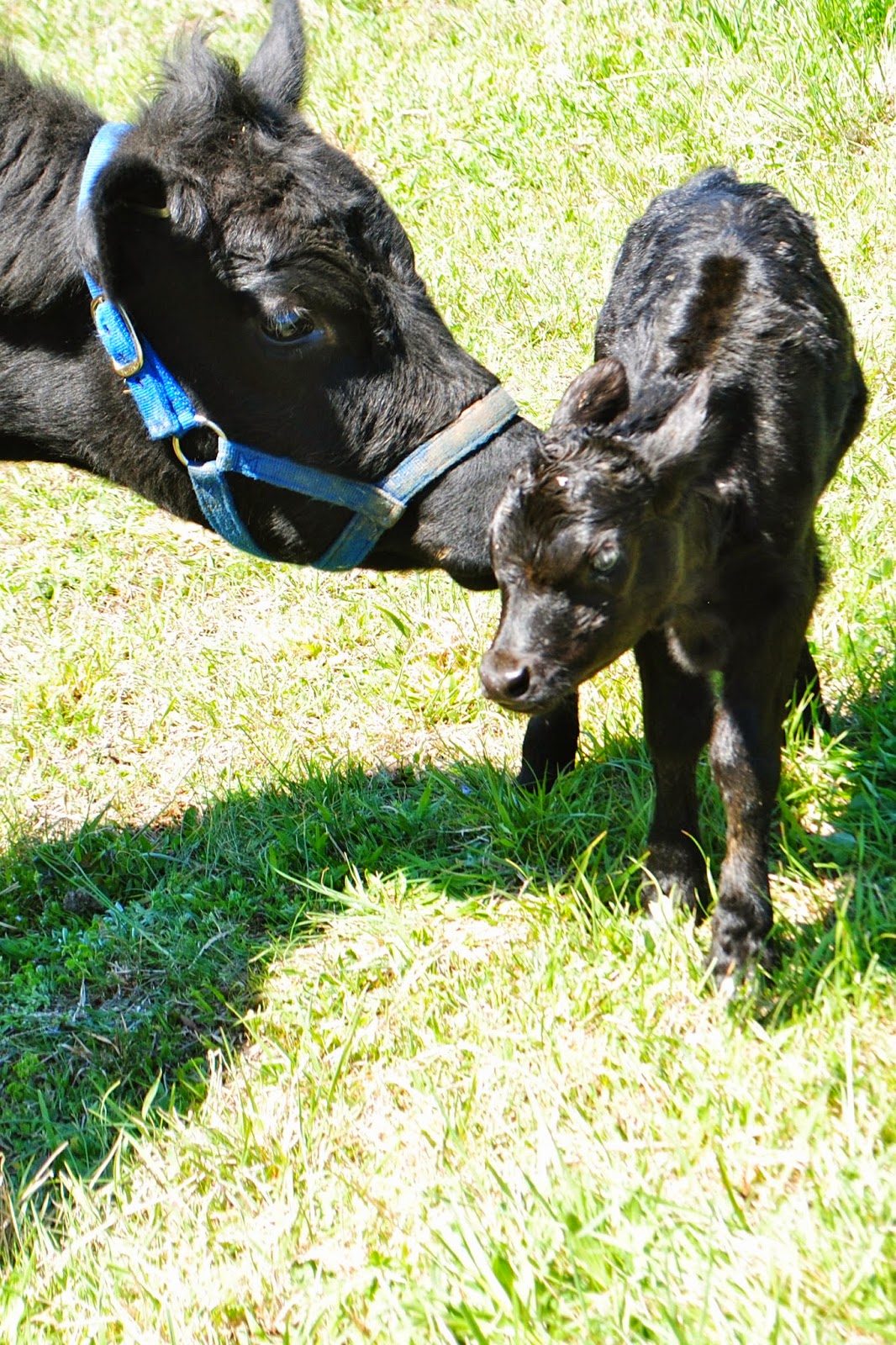
So much for doing a post on Ebony's calf watch--I guess she heard I was going to plaster photos of her private parts all over the internet, so she pre-empted me!  After I got up this morning, I went to check if Ebony was still lacking some progress toward calving and if I could safely spend the morning with the grandkids--and found a calf!

Wasn't it thoughtful of Ebony to let me know she appreciated the shade shack by giving birth in there?  Not knowing there was a calf, I brought the dogs, but they got taken back in the house pretty quickly!

Meet NewHope Mrs. Tiggywinkle out of New Hope Ebony Belle, by Woodmagic Hedgehog III.


She walks like a Walking Horse!  Can that girl move!

She's quite adventuresome, and Ebony has a time keeping up with her.


Ebony guzzled down her bucket of warm molasses water.  She says, "Thank you, nice KFC people, for telling Susan about that!"


When I picked Tiggy up to carry her on the scale, she let me know what she thought of THAT!  Well, at least I know she's eating and the plumbing is working!  Calf poop is good, even down my leg, when I know everything's fine.

No lady likes to have her weight broadcast in public, but this little gal is a lot heftier than she looks, all 40 pounds of her.  No wonder I was huffing and puffing carrying her up the steep hill this morning!

There they go, sweet new baby and attentive mama.  We're so thrilled to have Mrs. Tiggywinkle here on Zephyr Hill Farm!


Sunday, March 30, 2014

Signs That You Might Have a Serious Disease

While I was finally cleaning up my kitchen this morning, I was thinking how much I would rather be doing something else.  I began to add up all the signs that I might have caught a serious disease, one that's incurable, actually.  So here are some signs to help you tell if you might have caught the same thing . . .

You'd rather be cleaning your barnyard than your house, and shoveling manure beats out washing dishes any day of the week.

You are seriously in love with a bovine.

You spend a lot of time with your head under your cow's belly shooting photos of her udder . . .
. . . and looking under her tail to see if she's about to calve.
The sight of a mama cow with her newborn calf just thrills your soul.

This isn't gross, it's good news.
When your first calf has her first calf, that makes you a grandma.

You mount a four-person team effort to go out in the pouring rain and rescue a newborn calf.
A milking stanchion is at the top of your Most-Coveted Wish List.
Your cows get more attention than your horses.
A slimy, slobbery kiss makes your day.

You think nothing of making a ten-hour round trip to get a new cow from an excellent breeder.

When you go on vacation and your host asks what you would like to do, the first thing you say is, "Visit a Dexter farm!"
Milking your cow is your favorite part of the day, and you never cease to marvel that God has created this cow to produce milk for her calf and yet, in His plan, she generously shares it with you.

A jug of milk fills you with joy and satisfaction.

You get seriously excited over the arrival of a cow-related package.

This makes you smile.

You buy a brand of whiskey you've never tasted because your new bull has the same name.
The sound of milk hissing into your pail is music to your ears.
This doesn't make you gag, it makes you smile.
You have hugged and kissed a cow today.
You've taken "felfies" of you and your cow.

You're out there every day, no matter the weather, to make sure your animals are taken care of.

You ship a bull clear across the country so that you can add the best genetics to your herd.

You're willing to do whatever it takes to get your cow well when she's sick.
Your life-long fear of power tools goes out the window when your cow needs something.

You can't ever have too many!
 
Yellow fat on your beef makes you happy.


You bore your family and friends talking about cows and wish that just one of your cow-loving friends lived closer.

You happily break up your beautiful view with fences because that means more pasture for your cattle.

Green is your new favorite color because it makes your cows happy.

Your new vocabulary includes words like teats, udder, quarters, top line, conformation, heat, and AI.

Genetics has become a fascinating subject, and you draw Punnett squares to figure out what your next calf might be.

You have come to think that a cow is one of the most beautiful animals God created, and you wonder how it took you so long to discover that.

If you have several of the above symptoms, you have probably caught the same disease I have . . . Dexteritis!  It's incurable--but go ahead and try to cure it by getting some more.  You might as well enjoy it!