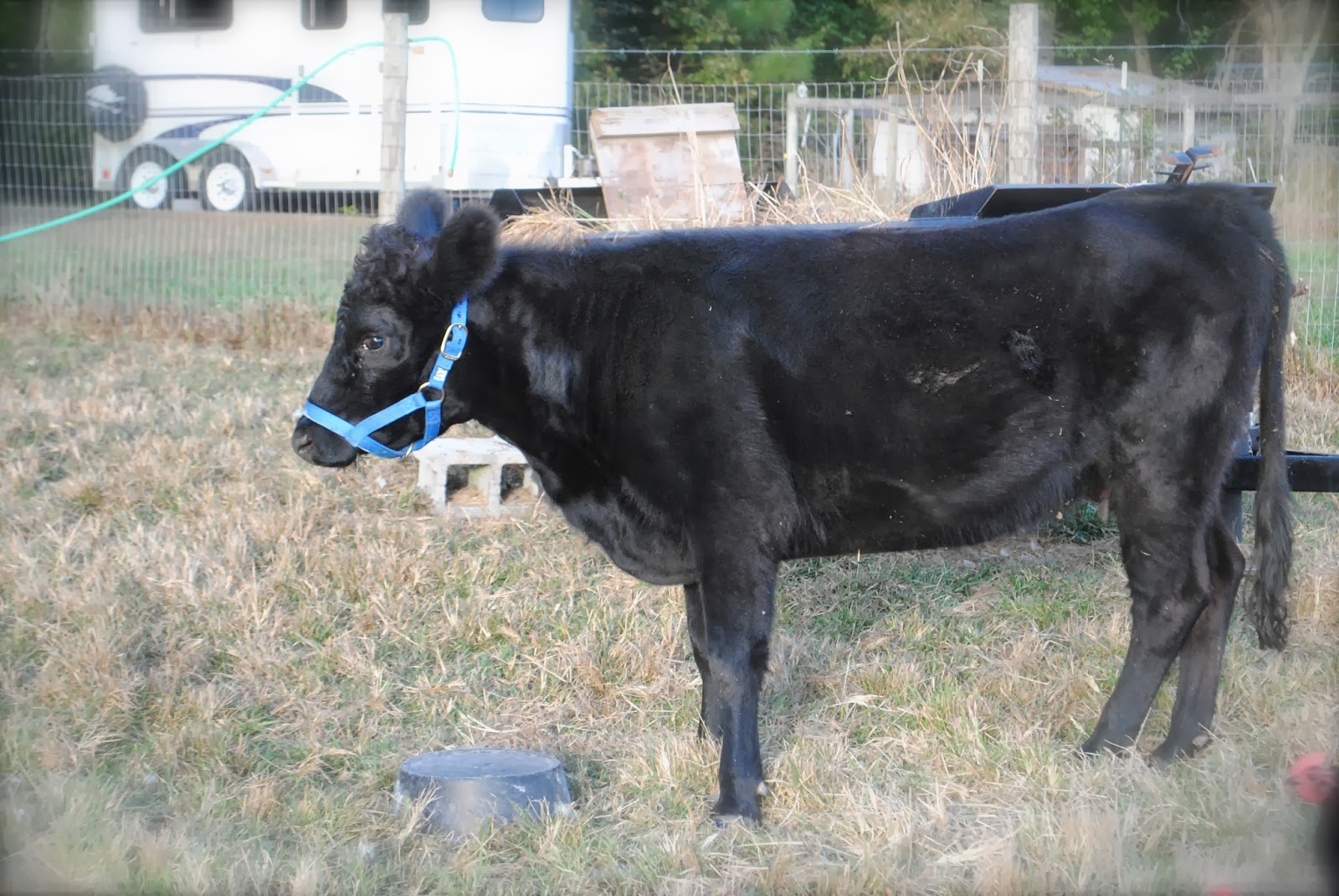
A reader recently asked how we determine what to breed for, and it got me thinking. There are certain things that are very important to us in our breeding program, others that are less so. But we had never sat down and put a list in writing, much less tried to list our priorities in order. It took a lot of thinking and re-writing! So here, by request, is a first attempt to list our priorities for breeding.
1) Temperament. For us, if our Dexters are to be family cows, good temperament is an absolute requirement. Warning: Aggressive animals will be eaten on our farm!
We halter train our heifers, and our bull is halter-trained. It so happened that we needed to move both him and a heifer in season from one pasture to another. We put his halter on, clipped a lead rope on hers, and we each led one. It went very well. Of course we don't TRY to plan to disrupt a breeding pair, but it's good to know that if we have to, we can safely do it.
Many are the times we've been thankful to be able to walk up to an animal in the pasture, put on a halter or clip on a lead, and take it where we want it.
It's extremely important to me that my cows don't kick or even look like they want to when I'm milking and that I can handle their calves without trouble. For us, this is the essence of a "Family Cow."
2) Calving ease. Any cow can have a wrong presentation and a difficult delivery; if it happens again, it's time to check whether the cow has a problem. A low-birth weight bull is a great asset to calving ease. One of the best things about our Dexters (and Dexters in general) is that they have calved without difficulty and have good mothering skills with little or no help from us. Waking up in the morning to a healthy, dry, nursed calf is a huge blessing!
3) Dual purpose, meaning equal emphasis on beef and milk. For beef you want good muscling, length, good width across the body, and good depth through the heart girth.
For milking you want good milk production with plenty of butterfat and protein (also necessary for raising a healthy calf). You want good udder conformation with a level floor, good front attachment, high rear suspension, good spacing of teats and well-shaped teats. A cow with "sausage teats" that a small calf can't get hold of to nurse becomes a burden.
Temperament is especially important for a true dual purpose animal. The cow with the greatest milk production in the world is worthless if she tries to kick your head off every time you milk her!
4) Good conformation. We wouldn't cull an animal with less than perfect conformation if it has other good qualities. We would breed it to a better animal to try to improve on its faults. This is why a good bull is so important, since he is going to contribute his genes to every calf born on the farm.
Good feet are an often over-looked part of conformation, hidden away in the grass as they often are.
Note: One of my pet peeves is breeders whose animals have "good confirmation." We have yet to take a cow to church and serve it communion, and until we do, I'm afraid none of our animals will have "good confirmation!" But we hope they will have
good conformation!
5) Polled. Our foundation cow (left) had horns, and we knew we didn't want to deal with them, so choosing a homozygous polled bull for her was a very high priority. Our current herd sire is heterozygous polled. Being homozygous polled would have made him "Perfect," but he is so excellent in every other respect that we wanted him even with one horned gene. With all our breeding stock being heterozygous polled, we will eventually have a horned calf, but we are willing to dehorn it. What we don't choose to do is to keep both horned and polled animals together. For our safety, the safety of our grandchildren, and the safety of our other animals, we have chosen to go hornless.
6) A2 status, homozygous A2 (A2/A2). The photo of our granddaughter eating yogurt is here because our family's health is the main reason we are interested in the whole A2 issue. While it may not have been conclusively proven to the satisfaction of the dairy world at large, we like the idea of breeding for A2. When we decided not to keep our A2 foundation cow (pictured above), we did decide to replace her with her better-tempered, polled, A2 granddaughter. However, we plan to keep our A1/A2 cow because of her sweet temperament and easy keeping. In looking for our herd bull, homozygous A2 status was a priority. You can cut horns off, but you can't filter the A1 out of the milk! However, A2 is only number 5 on our list because we feel other things are more important.
7) Grass-based. Also for our family's health, we want to raise grassfed beef. Our steers should finish well on grass, and our cows should be able to raise healthy calves without a lot of supplemental grain. Currently we feed one cow 4 pounds of 16% protein feed a day, while the other gets 3. Their calves are 6 months and 4 1/2 months old, respectively, so both are at their peak lactation. Both calves are on their dams full time with grass, hay and minerals. Both are healthy and shiny and chunky. Our vet is happy with the condition of the cows on this amount of feed, less than the rule of thumb would dictate. (The rule of thumb is 3 pounds of 16% protein per gallon of milk.) I know of full-sized dairy cows that consume a 5-gallon bucket of grain twice a day. Ours get four (or fewer) tomato-cans full per day!
8) Size. Our aim is to stay within the ADCA height guidelines. Again, we would not necessarily cull an animal based on this, but we will breed toward that goal. We love Dexters partly because of their size, and we have no desire whatsoever to "upsize" them to get more beef or more milk.
9) Color. I put this last because it's just the gift wrap, as far as we're concerned. Beef and milk from black, red or dun cattle taste exactly the same. That being said, we were thrilled to get our first red calf this spring. They sure look pretty on the green grass, they're a lot easier to spot at night, and there's anecdotal evidence that they are less troubled by flies. (That's something we'll be watching.) Both of our cows carry red, and now that we have a red herd sire, we'll be getting some red calves. That's just window dressing--fun, but not important to us.
There are other things I didn't list, even some things we test for (or will test for). Here's why they didn't make the list:
PHA - All of our animals are PHA-negative and always will be. There would be absolutely no reason to add a PHA-positive animal to our herd. I believe that almost every Dexter breeder with a PHA-positive cow is trying to breed a replacement heifer. Many with PHA-positive bulls have castrated them, despite their other great qualities. We don't test for PHA any more because our animals are obligate non-carriers.
Chondrodysplasia - We bred a cow to a chondro-positive bull, twice. We got one sweet non-carrier heifer and a carrier bull (pictured above). While we love our sweet, chondro-positive bull calf, we have personally decided not to breed chondro carriers. We will be castrating this bull calf and raising him for beef, NOT because of his chondro status, but because of his dam. And THAT is another post for another day: "What Makes a Bull Mother?" Meanwhile, he's looking like mighty tasty beef!
Kappa Casein & Beta Lactoglobulin - These are milk components that can be tested for with other DNA tests. If they were computer programs, you might call them A2-2.1 They relate to cheese-making, and while they are interesting--and we've already tested one animal for them--they will never be a reason to cull an animal. They fall into the Fun-to-Know category, that's all.
So there it is, our breeding priorities at 6:29 p.m. on October 8, 2014. And now we've got some hungry animals waiting for hay!