Stories of life on our farm in Northwest Georgia where every day is an adventure in this beautiful spot that God has entrusted to our stewardship.
Showing posts with label Veterinarian. Show all posts

Friday, May 29, 2015

When God Sends a Gift

Driving home from Chattanooga on a couple weeks ago, I suddenly stopped the car in the middle of the road.  There near the edge of the road, heading into a patch of dense woods, was a tiny puppy--too tiny to be wandering alone.  I called the puppy and it came right up to me.  I picked it up and drove to the nearest house to see if it was theirs.  It wasn't, and all we could assume was that someone had dumped one more defenseless puppy out in the country, although we couldn't figure out why on earth someone would dump such an adorable, friendly puppy.

I called every vet we know, but they were all closed for the weekend, so I drove home with the puppy curled up in my lap.  Kara pitched in, and we gave the puppy some water, which it lapped thirstily.  We fed it a bit of milk and some congealed meat juice, then gave it a bath.

As we bathed it, several things became obvious:  It was a boy, it was skin and bones, and it was swarming with ticks.  I started removing ticks, but it soon became clear the puppy needed more help than I could give him at home.  Kara offered to drive us to R.I.V.E.R., the emergency animal clinic in Chattanooga, so off we went.  On the way, we decided to name the puppy Kona, Hawaiian for "trade wind."  The first dog we had in France was named "AlizĂ©e," which is French for trade wind, and it seemed to fit my theme of wind names which began with Zephyr, Misty (Mistral) and Jet.
At the animal hospital a sweet tech named Becca took us to a room.  She began to remove ticks, and we counted as she pulled them off and dropped them into a vial of alcohol.  After a while, Kona got some prescription dog food and Becca drew blood.  While she went to run the tests, I kept removing ticks.

By the time the vet came to see us, we had some numbers:  At approximately six weeks old, Kona weighed 2.5 lbs. instead of the 5 lbs. he should have weighed.  Even after eating, his glucose was only 62 instead of over 100, which it should have been.  The worst news was his PCV or percentage of red blood cells.  Instead of a normal of 35, Kona's was only 11.  That explained his white gums and tongue, as well as his weakness and lethargy.  Basically, his life blood was being drained by starvation and the ticks.  We were up to 180 by the time I left, and before Becca was done for the night, she had removed over 200 ticks from Kona's tiny body.  She told Kara and me that her previous record in school was a full-grown pit bull that had 100 ticks on it.  I'm not sure that's the kind of record a puppy wants to break at such a young age!

In consultation with the vet, we decided to leave Kona overnight for treatment:  IV fluids, a blood transfusion, prophylactic antibiotics for tick-borne diseases, treatment for intestinal parasites, and a re-feeding regimen.  The vet called us before she left for the night and told us that the blood transfusion raised Kona's PCV to 20, and that he stood and wagged his tail.  When I heard that news, I was pretty sure he would make it.

Before we headed home, Kara called and gave Herb the heads-up that I had found a stray puppy, was getting it treated at the animal hospital, and planned to keep it.  Herb thought she was joking!  He told me later he didn't mind me helping the puppy, but he sure didn't want another dog!  I told him that the puppy had snuggled right into my heart, but that he was going to need a lot of care to recover, and meanwhile we could keep an open mind . . .

Sunday we brought Kona home, quite an improvement over the bedraggled creature I had picked up the day before.  Kona met Hero . . .
. . . and Misty.  He wasn't afraid, just respectfully humble the way a teeny puppy should be.

The grandkids were at the house, and they couldn't wait to meet the new puppy.  Hugs and cuddles were shared all around, and Kona generously handed out kisses and tail wags.  The eldest asked, "Are you going to keep the puppy?"  (Smart little girl!)

Kara told her to ask Didi.  (Smart young woman!)


Take a look at the way our youngest granddaughter clutched Kona in her arms, and tell me what you think Herb said . . .


That was an easy guess, wasn't it?!

Yes, Kona has a home!  I told Herb that his appearance at the exact moment I drove by was an "act of God," and I meant it.  It's incredible to me that such a sweet puppy could have been discarded, but God did not intend this special part of His creation to be wasted, so He literally dropped Kona into my lap!

I remember telling one of my daughters many years ago, "When God sends you a gift, even if you didn't ask for it and even if the timing isn't what you might have chosen, you don't say, 'No thanks!'  You take it in both your hands and say, 'Thank you!'"

So . . . thank You, Lord!

Update:

With company over Memorial Day weekend and the arrival of Siobhan's calf, I didn't get Kona's story posted. However, he quickly wagged his way into all of our hearts.

Just a few days after his arrival, he was sleeping in my lap when Herb walked by. Kona woke up, jumped up wagging his tail, and whined for Herb. I told Herb Kona wanted some loving, so he came over and petted him. Kona kept whining until Herb picked him up. Then Kona settled into Herb's arms and gave tiny little moans of delight, while Herb stood there grinning in delight, too.

Yesterday I spent about five hours treating Siobhan (that will be another post) for mastitis.  When I came in at about 8 pm, I found out that Kona had been acting like he was trying to throw up.  He began doing it more frequently, wheezing at the same time, and about 10 pm Kara drove us to RIVER again.  There we learned some very sad news.  Kona has food bloat because his food has not moved through his stomach and intestines properly, although I did ask our vet about his distended tummy.  He also has aspiration pneumonia with fever, which is causing the wheezing.  And finally, he seems to have megaesophagus, probably the congenital variety, which often appears at weaning, leading to emaciation (and perhaps making him prey to so many ticks) and aspiration pneumonia.  This would explain--although never, ever excuse--why someone might have dumped such a precious puppy.

We had to leave Kona at RIVER again, and it looks like he'll be there for a while longer.  He's still bloated, though somewhat better.  (My concern is whether the lack of esophageal peristalsis carries into his intestines and what that would mean for his prognosis.)  His fever is a little better, but his breathing is still difficult.  He's in an oxygen box, receiving antibiotics and nebulizer treatments.

When Kara and I went to tell him goodbye last night, I picked him up out of the oxygen box, and he wagged his little tail like crazy and licked all over my face.  Kara got the same treatment.  When we put him back, he was so weak and tired he laid down at the edge and peered out at us.  I said, "Look Kara, Kona's looking at us!" and he wagged his little tail again.

We're asking God for another gift, that He would heal Kona so he can come home again and have a chance at a happy life.  This little puppy is a ball of love, which he lavishes on all comers, and we love him right back.  Right now there's a huge Kona-sized hole in our home.

Saturday, February 21, 2015

Wellie's Castration Story

When we decided last summer that Wellie would be castrated, I talked to our vet about when and how to do it.  He advised doing it when Wellie was 4-5 months old, by cutting rather than banding.  He wanted to wait until Wellie was old enough for his vaccines and fly season was past.

He said he would give Wellie a shot of tetanus antitoxin as well as a tetanus vaccine (and his other vaccines) at the same time.  In the absence of a previous tetanus vaccine, the antitoxin would prevent any chance of tetanus while the vaccine built up immunity over a two week period.  We had heard tragic stories about people who castrated calves and gave tetanus vaccines, only to have the calves die of tetanus before the vaccines could build up immunity.

Unfortunately, life got in the way for the vet and us, and we were unable to get him here when planned.  Finally, I decided that at 8 1/2 months Wellie really needed to be castrated, and I called another vet.  (We like to keep good relations with several vets for cases just like this when one can't make it.)  The second vet also prefers castrating as less painful, uses the same tetanus prevention protocol, and agreed to use a local anesthetic.  So we set a date for the deed.

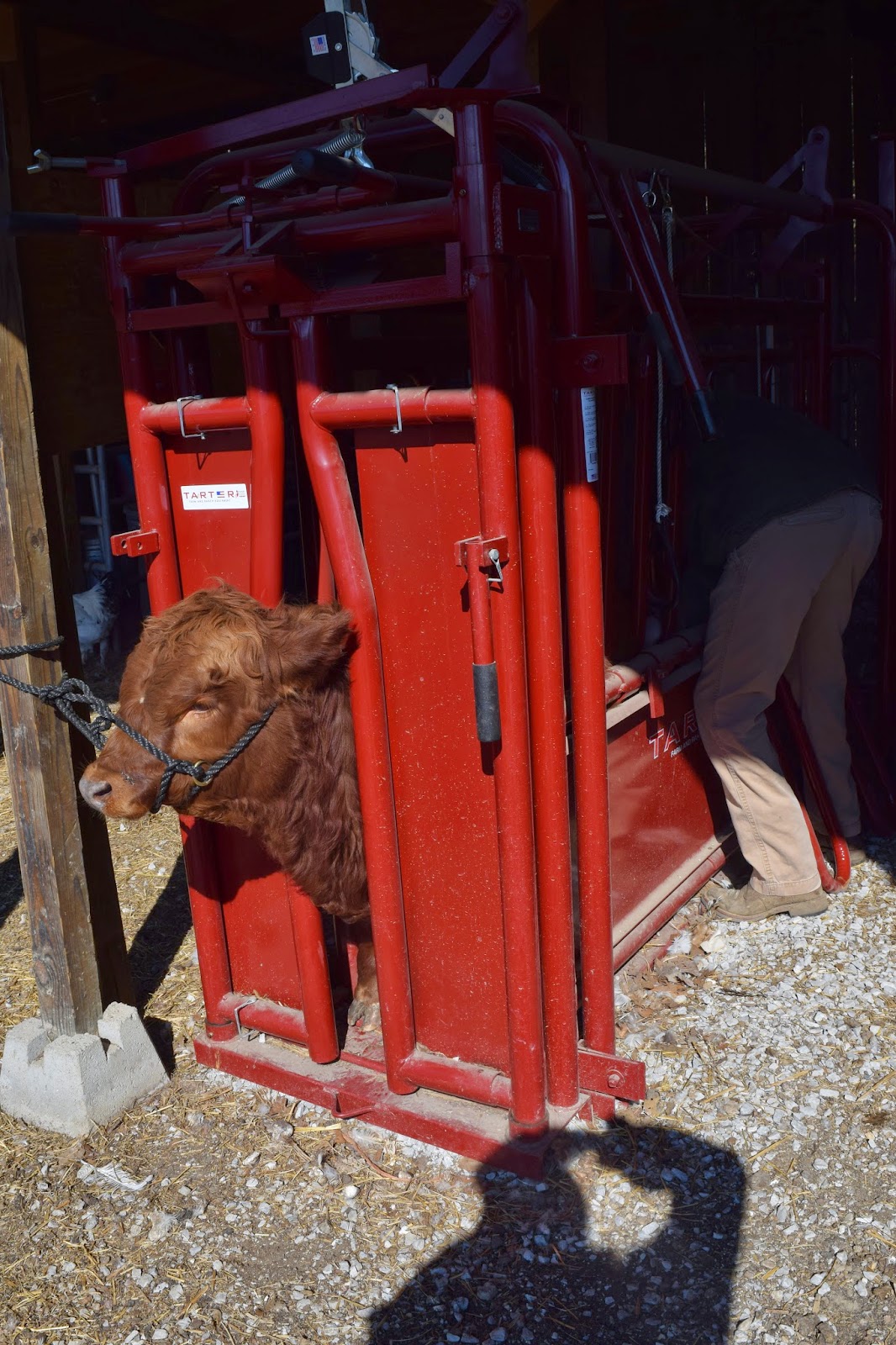
On Feb. 11 we put Wellie into the squeeze chute.
The vet folded down several of the squeeze bars so he could reach Wellie and administered the local anesthetic.  He gave it time to take effect while he gave vaccines to Wellie and Ebony.


I saw that the vet used a tool called a Newberry knife and made a slit in the back of the scrotum.  After that I went up by Wellie's head and did not see the actual operation.  I learned later that some vets cut off the bottom portion of the scrotum to allow for drainage, but ours made an incision in the middle.  It bled a little, but not much, and the vet said it would swell up and remain swollen for several days.  When I asked about disinfecting the site, he said I could use 1/2% iodine, so I sprayed some on.

During the operation, Royal came over to check on Wellie.  Of course, when it was his turn later to get in the squeeze chute to get a magnet, he did NOT want to go in!  I assured him that considering the per capita price we had paid for his testicles, they were quite safe!

Wellie jumped more over his immunizations than he did over the local.  He struggled a bit during the surgery, but less than I have seen cows fight over a shot.  Although the vet says they have more pain with banding, I don't think there is a painless way to castrate.

I know some farms do not castrate meat animals, but we simply do not have enough pastures to keep intact bull calves separate from cows and heifers.  As he has gotten older, Wellie has engaged in more head-butting challenges with Royal and Sir Loin, the older steer.  Being so small, he gets pushed around, and although he has never been hurt, I hope that he will now act less like a bull.

I do not like castration.  I wish it didn't have to be done, and I'm sure Wellie did, too.  But if we are going to be responsible breeders, we have to make sure that a bull calf that is not breeding quality is not breeding our cows and heifers.
I kept a frequent eye on Wellie to be sure he was okay.  The rest of that day and the next, he was moving slowly (to be expected), but was nursing, eating hay and chewing his cud.  Then on the morning of the 13th, I found him laying partly on his side with his legs spread out as if to keep them off his swollen scrotum.  When I got him up to check on him, his rumen was hollow (showing he had not eaten a lot of hay), and he looked peaked.  Half of Siobhan's udder was full, so he had obviously not nursed much, and I decided to take his temperature.  It was 24° out, so Wellie might be expected to register lower than the bovine normal of 101.5°, but his temperature was 103.9°.

I was quite concerned and called the vet, who had gone out of town!  Not only that, his partner does not do farm calls, and he didn't have another vet to cover for him.  So I called the original vet I had hoped to have do the castration.  He agreed that Wellie's temperature was too high and said if I would meet him, he would give me an antibiotic.  I made the two-hour round trip and came home with Excede, a long-lasting antibiotic, as well as a bottle of Banamine to relieve pain and fever.  Pain inhibits animals from healing, and when they are given pain relief, they tend to heal more quickly.

Herb was gone all day, and I was pretty sure from previous experience giving shots to cattle, that I would not be able to do it alone, even with the squeeze chute.  So I called on our neighbor, Randy, who came over with his son to help.  Excede is very thick and must be given sub-cutaneously behind the ear--never in a vein or muscle--using a large-bore needle.  Banamine goes in the neck muscle with a smaller needle.  Wellie objected strenuously enough, even in the chute, that I was very thankful for help holding him.

Randy, who grew up with cattle and had seen many castrations, felt that the bulge of tissue protruding from Wellie's incision was not normal.  I had no frame of reference at all, but tended to agree with him.  When I posted a photo later, other cattle owners agreed.  Once Wellie was medicated, I took a bucket of hot water and cleaned the incision of dried exudate, making sure it could continue to drain as necessary.  I also applied oil of oregano around the incision on the advice of my family cow friends.  Within a couple hours, Wellie was obviously feeling better, eating better and had nursed Siobhan out.

Herb and I gave him Banamine the next morning to make sure he continued to feel well and eat well.  He objected much more vigorously than he had the day before, so I decided that if he felt that good, he didn't need any more Banamine.

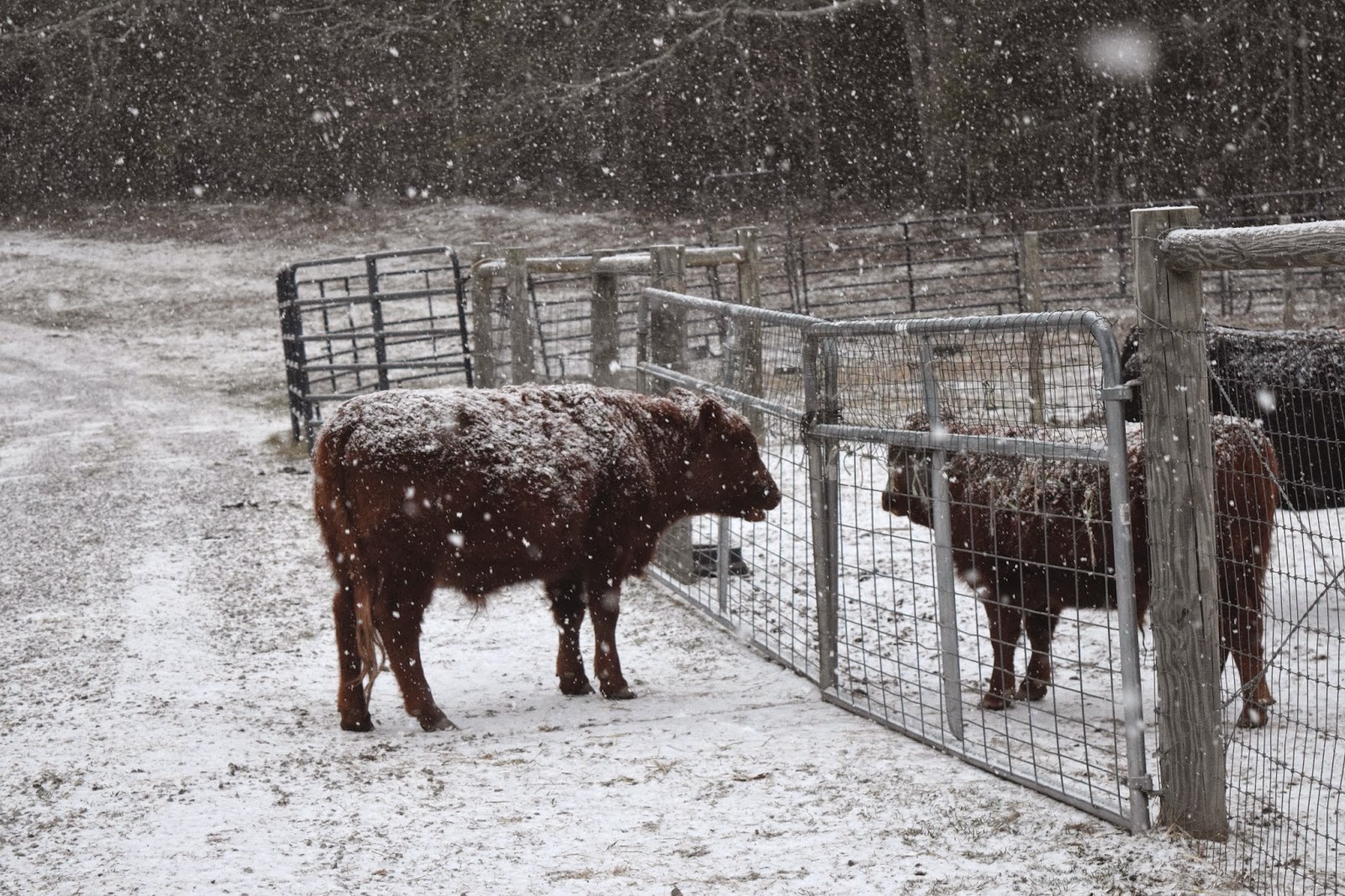
Wellie is back to normal now, and his scrotal swelling is gone.  He's eating well and acting lively.  Here he is visiting with his buddy Sir Loin at the barnyard gate.

Today Wellie wanted to nurse, and Siobhan pushed him away several times.  (That's another story.)  In a fit of temper, he charged one of the ducks.  The snow in the barnyard was slippery and crusty with ice, so Wellie hunched his back and crow-hopped across the barnyard, landing each jump on all four feet, pursuing the hapless duck who fled with flapping wings as fast as his short little legs could go.

Without a camera, all I could do was stand there and laugh.  The duck escaped with everything intact except his dignity, and I was just happy to see Wellie feeling so fine.

Saturday, January 31, 2015

Better Bite Bloat in the Butt!

Last spring I did a post about our first bout with bloat, a true bovine emergency.  We have now had a second bout with bloat--in the middle of the winter with no clover in sight!  So here I am, once again, to share things we're learning . . . so others can hopefully learn from our mistakes and avoid them!

This photo was taken on Jan. 19 in the early afternoon.  I was still recovering from the winter crud, and Herb had been doing almost all of the feeding since doing much of anything left me exhausted.

This was as adventurous as I got--using a telephoto lens to peek at the cattle enjoying a bit of shade on a warm winter day.

All five cows were chewing their cud together in the shade, but when I looked out a bit later, Siobhan was at the other end of the pasture eating on the hay bale.

I looked out yet again and saw the same thing--Siobhan skipping the cud chewing party to dine at the hay bale.  It was unusual enough that I told Herb I wanted to feed her evening grain and check on her.
I went out about 4:30 to check on Siobhan.  Siobhan was eager for her feed, and I let her eat it to keep her still while I checked her over.  It didn't take long for me to notice her bulging side and to be worried about her.  As long as she was still, I pressed my ear to her side and listened to her rumen.  There were no nice rumblings, just a few crackles--NOT good!  So I haltered Siobhan to take her up to the barnyard.  As I led her out of the pasture, she gave a little "drive by" poop that plopped down in two places as she walked--not a nice reassuring, I'm-not-budging-till-I'm-done-with-this-serious-buisness poop!  Take my word for it:  It's a fact of life with cattle, you WILL become a "connoisseur" of poop, and Siobhan's puny plops were just not doing it for me.

I took the photo (above) on my cellphone after we got to the barnyard, so I could text it to the vet.  While Herb walked Siobhan around, I went back to the house to get our "Bloat Kit," which consisted of a bottle of Therabloat and a large needle-less syringe to drench her with it.  (I sincerely hoped I could avoid having to use the plastic tubing that I bought in case I ever needed to shove a tube down a cow's throat into her rumen!)  The dark bulge at the bottom center of the photo is Siobhan's hip, and the large ballooned expanse bulging toward her head is her bloated left side.

This photo shows Siobhan's hip bone on a level with the switch of her tail.  You can see from the photo that her left side, where the rumen is located, is distended and very full, although not bulging up above her backbone.  My guess is that she was somewhere on the way from mild to moderately bloated.  These photos are of a cow that was more severely bloated, so severely in fact that her owner didn't stop to take photos until the cow deflated down to the stage shown in the photos!  Thanks to Louise of Carragheen Dexters for sharing her story and photos.  At any rate, Siobhan's rumen was very rounded and firm to pressure, and rumen sounds were absent.

Having been through this before, we knew the drill, and while we waited for the vet to call back, we took turns walking Siobhan rapidly around and around the barnyard.  She had interrupted Wellie's nursing to go eat her dinner, and she was extremely indignant that we were keeping her away from her baby!  So it really wasn't a challenge to keep her moving--all it took were occasional pulls on her lead rope to channel her energy in the direction we wanted.  Whenever I needed to stop for breath, Herb massaged Siobhan's rumen firmly to get the gas moving.  It sounds a bit crazy, but it really helps, and the massage was often followed by some encouraging gurgling sounds.  I kept laying my ear against her rumen, checking for those melodious notes.  If you spend much time around cattle, you'll also become a fine arts aficionado--feeling your heart lift to a nice tenor rumble or plummet to hear a soprano cellophane crackle.

After about 15 minutes of this, I was not happy with our progress.  Siobhan was still bloated with no good rumen sounds and no burping, and she began to arch her back like she wanted to poop.  She did this every few minutes, with no result at all or just a measly bit of poop.  This is a sign of physical discomfort and stopped up "plumbing."

So into the squeeze chute she went.   Cows make terrible patients!  They do not understand, "I'm doing this for your own good," so a squeeze chute is invaluable when a bloating cow needs to be drenched.  The squeeze sides held her still, with Herb's help to hold her head, while I got the syringe filled with Therabloat into her mouth and squeezed it a bit at a time down her throat.  You can't hold her head too high or she'll choke, but if you let her drop it down, the precious medication runs out.  You have to develop a feel for when the head is in just the right position so the only option is for the patient to take what's coming to her and swallow it!

About that time the vet called back.  He suggested we give Siobhan Gas-X, which is simethicone, but unfortunately that was about the only gas remedy that Herb didn't have in his medicine cabinet!  Since we had just given the Therabloat, we decided we would wait it out and give it time to work.  Herb really had to finish some case notes, so he went back to the house while I continued to walk Siobhan rapidly around the barnyard.  I still wasn't happy with her progress, so I started calling Dexter friends that might have dealt with bloat.  I was very thankful when I heard Melissa Parker of Nonesuch Farm on the other end of the phone.

Melissa had dealt with bloat before, and she had some excellent advice besides the Therabloat and massage.

  • Keep her moving!  
  • Get her chewing!  Tie a bit or a stick in her mouth to make her chew, which will make her burp.
  • Cut out her grain for a few days.  Cows can get acidotic after an episode of bloat, and we needed to withhold grain for 2-3 days.

This photo is not the best quality because it was taken at about 6:15 as it was getting dark, but you can see the bit I rigged up for Siobhan.

Luckily I had a large (size 5) Dexter halter, a snaffle bit with big side rings, and a couple of spare carabiner clips--and voila!  Siobhan's Big Blue Bloat Busting, Belching Bitted Halter!

Believe me, Siobhan was NOT amused!  Unfortunately, I can't offer any videos of how her halter worked because by that time we were bouncing quite indignantly around and around the barnyard, but the bit was what finally turned the corner.  Siobhan was definitely chewing at it--trying to spit it out--and it wasn't long until I heard a lovely rumbling belch!

I listened for regular rumen sounds, counted three long belches, and noted a couple of decent poops.  Best of all, there was a hollow in Siobhan's rumen where before it had resembled a large, firm beach ball.  A half hour after the bit went in, I pronounced her "cured" to the best of my ability.

It was also almost pitch dark, and I could barely see to lead Siobhan back to the pasture.  She was a black shadow fading onto the dark hillside, first calling loudly, then in soft mama moos.  After a few moments, a small shadow at the bottom of the hill baby moo-ed back, and Siobhan took off galloping and bucking down the hill to find her calf.  All's well that ends Wellie, I guess.

The question we had to figure out was WHY did Siobhan bloat?  This wasn't the frothy bloat that Ebony got from lush clover in the spring.  So what happened?  This excellent article on bloat gave me a few answers.

  1. Earlier in the winter the cattle were eating coarser first-cut hay.  About a week before this happened, we put out a new bale of finer second-cut hay.  I was concerned that it might not have enough roughage, and I've since been told this could have been a factor.  The cattle did have constant access to the hay bale, which is very important, but after the bloat episode, I asked Herb to throw some of the horses' coarser hay (from an older bale) over the fence for the cattle.  Believe it or not, they actually left the "nicer" bale and came up the hill to eat the coarser hay, Siobhan included.
  2. I'm the one who replenishes the minerals, and with being sick I had not thought to ask Herb to check on them.  If the animals' salt consumption decreases, they may drink less water, which can contribute to bloat.  I can't remember now if there were minerals left in their tub at the time or not, but it's an easily avoidable bloat factor that I won't forget again.
  3. We had recently switched Siobhan from 11% all-grain sweet feed to 14% non-GMO multi-species pellets.  The article on bloat cites small feed particle size as a contributing factor for bloat.  Small particle size is found in pelleted feed, as opposed to all-grain.  I had been sure to make the change gradual and added probiotics to Siobhan's feed during the process, which is the way to change feed.  However, given the way pellets break down more quickly in the rumen, it seems likely that the feed itself was a contributing factor.  This is not enough to make me switch back to GMO all-grain, but it is enough to make me watch more closely.  After withholding grain for three days as Melissa suggested, I worked Siobhan back up to a pound twice day instead of 2 pounds twice a day.  She doesn't really "need" the grain to maintain her weight, so she now gets it just to keep her coming up to the barn twice a day, which makes it easier when I want to shut her up for milking.
  4. The weather had suddenly changed from a week with  daytime highs of about 32° to a high of almost 60° the day Siobhan bloated.  As surprising as it seems, weather changes are a factor in bloat.  Obviously, that is nothing we can control, but we can be aware of it and be more vigilant for other potential factors that could cause bloat.
As emergencies go, this one was kind of an "also ran".  I'm not sure that Siobhan's life was in danger, and she might have recovered with no treatment at all.  However, I was not willing to take the chance when a $3 bottle of medication and a couple hours of my time might make the all the difference.  This episode has reinforced in my mind the importance of several things:  Constant access to free choice hay and loose minerals; daily interaction with your animals to check on them; familiarity with their normal habits; and keeping a box of basic emergency supplies available.  

There's one more thing our "bloat kit" needs (besides a new supply of Therabloat), and that's a trocar.  A trocar is definitely one of those tools you hope you never have to use.  It's similar to a hollow ice pick that you stab into the cow's rumen to allow the excess gas to escape.  It sounds horrendous,  but it beats losing your cow.  One woman I know, who lives in a remote area far from vets, found her beloved cow down, seriously bloated and gasping for breath after getting cast in the barnyard.  Knowing that her cow was dying, this gal grabbed the steak knife she used to cut hay strings, cleaned it quickly in teat dip, and stabbed her cow in the rumen to let the gas escape.  That's not something any farmer wants to do, but as this gal said, when the alternative is watching your cow die in agony, you'd be surprised what you can do!

We know that no matter how well you care for your animals,  things can and do go wrong.  I'd much rather use a trocar than have to resort to using a steak knife on a living animal . . . so the emergency cow box is getting a trocar to add to the tubing, the syringe and the bottles of Therabloat.  If we never have to use them and they sit there gathering dust, it was cheap insurance!  If we should need to use our emergency kit, we'll be ready to kick bloat's butt!


Saturday, November 15, 2014

An Eventful Week in Review

This has been an eventful week that would definitely get mixed reviews.

On Sunday I found Robin laying out flat in the barnyard with one leg curled under her and the wing on the same side partially splayed out.  She was very cold and snuggled into me when I picked her up.  I brought her into the laundry room and put her in a milk crate lined with hay with some water and crumble at hand, and I put a floor lamp with lots of wattage next to her to warm her up.  She ate and drank a bit and seemed pretty bright-eyed, although she didn't seem at all inclined to move.

On Monday Kim Newswanger arrived to pick up Tiggy, and of course we went out to let Kim say hi to Ebony since Kim was her first mama.  You can imagine my shock when just as I was taking this photo, Kim said, "What's this?"  Ebby had a lump on the underside of her jaw just about where Kim's hand is in the photo.  Neither of us knew what it was, and it was very hard to see through the long hair under her jaw, but it was obviously painful.  There was a small scab which I picked off, and it had a small amount of pus on the inside.  A call to the vet was in order.

I had warned Kim that I have not been able to make friends with Tiggy.  This is as far as we've gotten--and only while she's eating!  As soon as the grain is gone she backs away from me.  Her "safety zone" has gradually gone down from about 10 to 2 feet, but she is definitely wary of us.
We had to corner Tiggy to catch her and put Kim's halter on her.  I've told Kim all along that she's a cow whisperer and that as soon as Tiggy meets her she'll melt in a big puddle of chocolate all over Kim.  It wasn't quite that dramatic, but Tiggy warmed up to her pretty quickly!

With a lot of coaxing, Kim led Tiggy out to the trailer, and she hopped right in!  One thing that made me feel a tiny bit better was that Tiggy was actually grinding her teeth as Kim led her--the process was apparently that agonizing!  She recovered quickly--after just a few days at her new home, she comes right up to Kim for treats and scratches.  I told Kim that my story (since Tiggy isn't telling a different one) is that this smart little cookie heard in utero that she wasn't meant to be ours, that she was meant to go back to live with Kim.  I think she's just been waiting all this time for her real mama to come get her, so why waste any affection on me?  :)

After Kim and Tiggy left, we switched animals to different pastures.  Now that Tiggy is gone, we don't have to keep Royal two pastures away from her, so we moved the cattle up to Kara's pasture, their winter sacrifice pasture.   Angel, Brandy and Julie had been in the back of Kara's pasture getting to know Romeo over the electric fence, but I wanted them to have a lot more room for their first official meeting so we put them all out where the cattle had been.  Of course everyone took off galloping!

While Angel and Brandy found some green grass, Julie went over to meet Romeo.

"Hi." BAM!  I guess being the smallest and lowest on the totem pole, she wanted to put him in his place right off the bat.

Romeo realized Julie was not his Juliet, and he high-tailed it out of there.

 Of course the harem followed right on his heels.


Don't we have a colorful bunch?  (In more ways than one!)

We also have some very opinionated ladies, and Brandy's opinion is that SHE is the Alpha mare!

Finally the girls hared off on their own and left Romeo alone.  He has always been a sweet, peaceful guy and pretty low on the totem pole as long as we've known him.

As the sun set, equine relations seemed to reach détente.

Meanwhile, I had called the vet about Ebby's lump, and he said he'd try to get here in a day or so.  I was worried that she might have something called "lumpy jaw," which I knew was serious, and I wanted to get her seen as soon as possible.


Finally I finally found a vet who could come on Wednesday.  So that afternoon we got Ebby in the squeeze chute to get her lump checked out and see what had caused it.  The vet shaved the lump and gave her a thorough examination, including looking inside her mouth.  Although he had never actually seen a case of lumpy jaw, he said that it is usually located farther back on the jaw, closer to the cheek.  He said that Ebby's lump seemed to be an abscess, probably caused by inflammation from new teeth, and it appeared to have already drained.  The lump, while still tender, felt thick and didn't have an open channel.  As a precaution, he cleaned it well with an antiseptic and took a swab in the small bloody spot that was visible after cleaning.  The culture would take a week to get results, and he told me to keep iodine on it in the meantime.  I felt reassured, although I was still concerned.

Wednesday morning I had noticed that Robin seemed to be going downhill.  Figuring it couldn't hurt and might encourage her to move, I fixed up a pen for her on the back porch in the sunshine and put her there with food and water.  She simply lay there, uninterested in anything.  When the sun moved, I shifted her to take advantage of the warm rays.  Later that afternoon when I came back to check on her after treating Ebby, poor Robin had died.  I was glad she'd had the sun on her back for her last morning.

Late Thursday afternoon I got a call from our main cattle vet.  He had hoped to get out here but wasn't going to make it, so he was checking on Ebby.  He said that he was pretty sure she had an abscess and that normally he would drain it and give her a shot of Excede, a long-acting antibiotic.  Since it had already drained, if I wanted to meet him somewhere, he'd give me the Excede.  So Friday morning I got Ebby into the squeeze chute and gave her the shot--although it wasn't quite as simple as it sounds.  Cows HATE shots!  Nevertheless, thanks to the squeeze chute, Ebony got her Excede.  I was glad to see that the lump had shrunk some more and was definitely less tender.

By this morning the lump looked smaller, although I think Ebby may always have a lump of scar tissue.  She let me scratch it, though, which I took as a good sign.

Herb had clued me in to something he had observed, and I could hardly believe what he told me.  So I took the camera with me this morning so that I could write a fitting end to the story of this week.

It may not be too surprising to see Romeo pin his ears at Julie and tell her to leave his grain alone.  After all, she was the first to try to kick his teeth in!
And it may not be surprising to see Angel, close to Romeo and warning Julie off, especially if you remember that Angel knew Romeo long ago before he went to Texas.  What is really astonishing is what you DON'T see in this photo--Brandy!  That's because Brandy was up eating hay . . . which she could finally do after Romeo left.

Meet Romeo, the new Alpha!  Angel--the only one who didn't try to kick him--is his sidekick, and Brandy--the former Alpha--is neck and neck with Julie for last place.  I think Romeo is saying that the moral to this story is:  "He who laughs last, laughs best!"

Saturday, November 1, 2014

If Cows Could Talk, Here's What They Would Say . . .

Dear Hopeful Cow Owner,

Before you decide to bring me home and keep me as a family milk cow, here are a few things you should know about me . . .


1) I am a ruminant. I eat my food quickly and burp it up to chew my cud. When I swallow, my cud goes to my rumen, a large “stomach” full of good bacteria that help me ferment and digest my food. My rumen produces gas, which I burp up.  This means I have different needs than horses and other animals you may be used to.

2) I am a herd animal and do not like to be alone.  I’d rather have other cattle for company, but even a sheep or a goat will do.  I also hope to be treated kindly by you because I depend on you.

3) I need some basic infrastructure—at least a fenced pasture, a shelter if you get bad weather, a small pen to confine me when needed, and a way to hold me still in case I need treatment. 

4) In most cases, I need free-choice hay. Even out on pasture, please keep hay available for me. The fiber helps me digest my food. No matter what some people tell you, please don’t feed me moldy hay. If you wouldn’t feed it to a horse, don’t feed it to me.  All pastures are not equal, so my “good green grass” might not be as good as you suppose. And those clumps of long, green grass? That’s where I pooped, and it’s not on the menu!

5) Avoid abrupt changes in my feed, whether grain or spring grass.  Change it gradually and keep it that way for several days before another change. This gives my rumen time to adjust.  And by the way, PLEASE keep all feed double-locked.  If I can, I will sneak in and gorge myself—and that could kill me.


6) I need plenty of water, and if my tank runs dry I will suffer. I use a lot of water for digestion and even more for producing milk. Even in cold weather I need water, and if it’s too icy I won’t drink enough.


7) I need free access to minerals. What I need depends on what part of the country you live in, so please find out what I need. Salt is only one of the minerals I need, and horse salt blocks aren’t sufficient for me.


8) I need shade, enough to lie down in to comfortably chew my cud--trees or a shed, I’m not picky.

9) Think about pests. Flies really bug me. They bite my udder and teats and can give me mastitis or pink eye. Please control the flies! Sometimes I get worms, even though you may never see them. Try to rotate my pastures, and take fecal samples to the vet twice a year. He will tell you what wormer to use for me.

10) I need vaccinations against various diseases and probably a rumen magnet, too.  An ounce of prevention is worth a pound of cure.

11)  Think about my love life.  When I'm in the MOOOd for love, I can bellow loudly, day and night!  If I don't have secure fences, I just might go looking for love in all the wrong places.  I won't produce milk indefinitely; I'll eventually need a new calf, which means either getting a bull, sending me off to a bull, or AI.  How will that work with milking me?  


12) If I should get sick or hurt, PLEASE call the vet if it’s beyond your skill! I can have calving problems, mastitis, milk fever, ketosis, bloat or other things that could permanently hurt or even kill me. If you want me to take care of your family and provide you milk and meat, please care for me in return.

13) And finally, if I’m ever suffering from sickness or injury or old age and not even the vet can help me, PLEASE give me the final gift of love, a peaceful death.

Now let me tell you what I will do for you . . .


1) I will look beautiful in your pasture, giving you joy just by being there.

2) I will give you a calf every year and raise it for you.

3) I will give you affection in return for scratches.

4) I will teach your children responsibility and where their food comes from.

5) I will keep you in tune with nature and the cycle of life.


6) I will give you manure to compost for your garden.


7) I will keep your pastures and your lawn mowed.


8) I will let you be the boss of me--or at least let you think you are.


9) I will give you a reason to get up and go outside every day.


10) I will even be your friend and companion, if you so wish.

11) With care and good management I will share with you the milk that God intended for my calf.   I will not begrudge it, but will give it generously.


12) And when my life is over, I will feed you one last time if you so desire

. . . for I am a cow.

I, the undersigned, do agree and covenant to fulfill my responsibilities toward you, my owner—

The Cow

Will you, Future Cow Owner, agree and covenant to fulfill your responsibilities toward me?  If you do, I have one favor to ask:  Before you bring me home, please buy a copy of Keeping a Family Cow, by Joann S. Grohman and read it from cover to cover!