Back in March, we got a new batch of chicks from a breeder in Tennessee. This seemed like a good idea for several reasons:
 They settled in happily, cheeping and foraging.

- The chicks would only have to travel for an hour or so instead of 2 days.
- We could buy fewer than the 25 required by most hatcheries.
- We could avoid dealing with hatcheries that kill most of the male hatchlings.
- We would be supporting a local business.
As Eva (let's call the breeder that) and I discussed which breeds of chicks to purchase, I was clear that my main goal was to try some new breeds of laying hens and that I wanted 6-8 of them. I wanted dual purpose chickens as we would butcher the roosters for meat. On Eva's advice, I ordered 4 each of Welsumers, Black Australorps, Light Brahmas and Ameraucanas.
 |
| One of each (from left to right): Light Brahma, Black Australorp, Ameraucana, Welsumer |
Unfortunately, there were a few problems from the moment I arrived to pick up the chicks.
- I found that the breeders live in a crowded residential neighborhood with no room for parking and no way to turn around.
- They put the box of chicks in my hands without letting me in the door (despite the clorox-soaked mat at the door) and without a chance to ask questions.
- They informed me that there were only 3 Welsumers, so they had given me an extra Ameraucana.
- They said I should use only newspaper sheets the entire time the chicks were in the brooder house as they would eat shavings and die. I found that strange since I had successfully raised a total of 63 chicks on shavings, but I followed their advice. One of the Light Brahmas died anyway within the first week.


At the end of June, Herb had to be out of town for a week, so I took over feeding the young chickens and moving the tractor daily. I took the above photo on June 29. Notice the three Light Brahmas (one hiding behind the waterer). A few days later, to my shock, there were only two Light Brahmas! One of the two cockerels was missing. How on earth could a chicken completely disappear? It was a mystery.


 One other concern about these chickens was that they did not seem to be growing well. They had plenty of fresh grass daily along with a daily ration of chicken scratch. Our previous batches of chickens had thrived on this regime, with our Freedom Rangers being ready to butcher before 18 weeks of age. The roosters had already reached sexual maturity and were beginning to get "roosterish" with each other. These chicks were hatched on March 17, and by 25 weeks old were still not full grown and had not reached sexual maturity. Herb hefted several and said they hardly weighed anything.
At that point, I consulted fellow chicken-raisers on the Farm Dreams website. The consensus seemed to be that they must have come from inferior breeding stock, the only thing that could explain the cannibalism and lack of growth since we knew from previous experience that it was not over-crowding or hunger.

During the night of Sept. 14, we moved the chicken tractor into the barnyard. The next day we opened it up and set the chickens at liberty in the barnyard. We figured they would gradually integrate into the existing flock, and Misty could guard both coop and tractor at night. That first day, one of the silly Ameraucana roosters flew over the fence back into the Home Pasture. Before the day was over, he disappeared--but this time only a hawk could be blamed. So now with the dead chick, two cannibalized chickens and the silly rooster gone, we were down to 12 chickens.
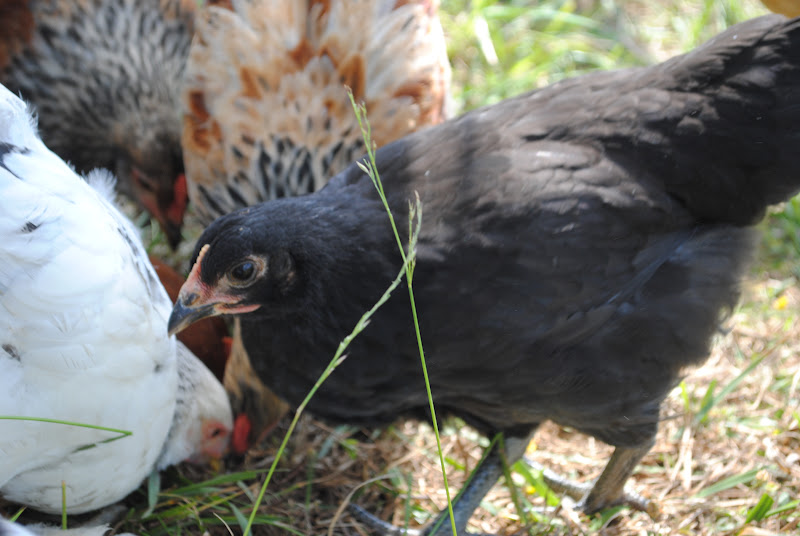
 Here the Light Brahma rooster tries out his wings. It's a good thing he did it then, because we clipped all their wings that night! No more escapees! Sadly, only four of the 12 are pullets. We have two Black Australorps named Whoopi Goldbird and Oprah Wingfry, one Ameraucana named Amelia Egghart (though her early adventuresome spirit has turned to timidity), and one Light Brahma named Temple Grayhen.
 Also sadly, for my sake, we have one very aggressive Welsumer rooster, running after me in this photo. I had to use that piece of rebar I'm holding to discourage his aggression! Welsumers are beautiful, the quintessential Kellogg's rooster, but I intend to dredge these in Corn Flakes and oven fry them!
 Crow about THAT, Mr. Kellogg!
 I'm a sucker for punishment, I guess, but after reading peoples' rave reviews of Black Australorp roosters, I've decided to spare one of them from the guillotine--probably this hefty guy. He needs a name, but I'll wait till I see how he behaves. The Light Brahma rooster is also going to get a reprieve, because they are supposed to be very gentle, too. If he ends up being (as I have read may happen) so big that he hurts the chickens, he can always make a nice Chicken Biryani.
 Fortunately, this mostly sad story has a somewhat happy ending. One of the young hens just laid her first egg yesterday. I know because it's smaller than the older girls', is a darker color, and has a couple spots of blood on it as is common with a young hen's first eggs. I have no idea whose this is, but I'll be watching to see. THAT's the kind of mystery I like!
I can't say "They all lived happily ever after," because as far as six of the roosters are concerned, that would be a lie. But some of the chickens will live happily for a long time, and we will sure be happy when we start getting some more eggs!

A short time later, Herb solved the mystery. One morning when he went out to move the chicken tractor, he found my favorite Ameraucana pullet, Margaret Hatcher, lying on the ground. The other chickens were pecking at the tiny bit of her that remained. It appeared that Margaret had been cannibalized. After an Ameraucana cockerel got pecked and bloodied (although it survived), we could only assume that cannibalism explained the mystery of the disappearing Light Brahma.

We knew the chickens weren't over-crowded. We had raised 26 Freedom Ranger chickens in the very same chicken tractor. They spent their entire lives in there without ever harming one of themselves.
As I observed the chickens closely, several more things became clear:
As I observed the chickens closely, several more things became clear:
- All three of the Welsumers were cockerels. I had learned through my research that Welsumers can be easily sexed at birth because the males are marked differently; that means Eva knew she was giving me three males. So much for those wonderful dark brown eggs she had told me about!
- Eva had pooh-poohed what I told her about hatchery Ameraucanas being "mutts" or "Easter eggers" rather than true Ameraucanas. She assured me that hers are true Ameraucanas. Well, they're not! Hers are mutts, too. The two Ameraucana cockerels in the photo above don't look like any of the colors specified in the Ameraucana breeders' standard. Most importantly, they don not have "muffs" like standard Ameraucanas. This lady is just breeding "Easter egger" hatchery chickens and calling herself a breeder.

At that point, I consulted fellow chicken-raisers on the Farm Dreams website. The consensus seemed to be that they must have come from inferior breeding stock, the only thing that could explain the cannibalism and lack of growth since we knew from previous experience that it was not over-crowding or hunger.

During the night of Sept. 14, we moved the chicken tractor into the barnyard. The next day we opened it up and set the chickens at liberty in the barnyard. We figured they would gradually integrate into the existing flock, and Misty could guard both coop and tractor at night. That first day, one of the silly Ameraucana roosters flew over the fence back into the Home Pasture. Before the day was over, he disappeared--but this time only a hawk could be blamed. So now with the dead chick, two cannibalized chickens and the silly rooster gone, we were down to 12 chickens.


I can't say "They all lived happily ever after," because as far as six of the roosters are concerned, that would be a lie. But some of the chickens will live happily for a long time, and we will sure be happy when we start getting some more eggs!